Word From Our Sponsor

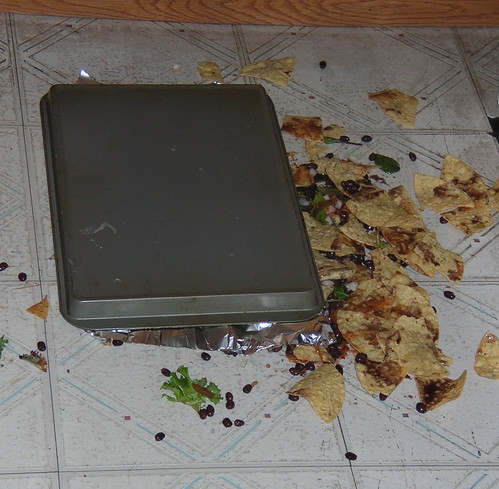
Bag of tortilla chips: $1.99

Can of black beans: $ .79

Small onion: $ .49

Spring greens: $ .49

Half jar of Newman’s Own Mile Salsa: $ .99

Time spent painstakingly arranging, preparing, slicing, sprinkling, spreading, and so on: 30 minutes

. . . .

Hearing a daughter’s bemused laughter: priceless

Self-Improvement

No, the length of this post will not correspond to how much I have to do.

I’ll tackle only two topics. First, my thumb: this morning I’m not concerned about my carpal/metacarpal joint, but the small wart on the center of my thumb pad. I have tried all the official non-clinical remedies, but this wart has endured for years. A few months years ago, though, out of the corner of my ear (so to speak), I heard someone on NPR talk about research on remedying warts using duct tape. So a couple of weeks ago, I decided to try it.

Results? Well, a number of people have been concerned about my sanity or my bandaid supply. The wart is persisting admirably, though I can’t really fault the duct tape; I’ve had to take it off and reapply it in order to lead services at church, and it may be that the tape stifles the virus’s airflow; by giving the virus little gasps of air at church, I probably just defeat the purpose of the whole exercise. But I won’t be conducting further research on the topic, though, because the duct tape tears the dickens out of my thumbnail. So when I say that you’ll have to take me warts and all, I mean it. For now.

The second topic is a little more sensitive. When I skimmed the book No Time that I received at the Twelfth Night party, I noted a section on the relation between stress and eating habits (no shocker there). The author noted, to the best of my recollection, that people who reported high stress levels tended to eat less healthy foods, and to be heavier. By the sheerest coincidence, the last few years have been particularly stressful for me, and I’ve drifted up to my heaviest weight ever. Now, as six-foot middle-aged guys go, I’m still in the normal range — but I reckon that this sort of trend merits resisting, so I’m gearing up to begin morning exercise again, and I’m trying to be less self-indulgent in my choice of foods (the almond horn pastry in the counter opposite me is calling out, “Come over, Akma; it is your destiny!” and my will power responds, “No-o-o-o-o-o!”).

I’d like to think this isn’t vanity, another instance of American weight/body-image-obsession, and I don’t by any means want to participate in the obloquy typically directed against people heavier than me. On the other hand, people my age and height ought generally to be more active, a little less paunchy than I am. We will see where this leads — but I’ll probably still have a wart on my thumb either way. A wart, but no duct tape.

To, By, Four

Wendy tapped me to respond to the “Four Things” quiz. I usually sit these out — as a professor and a priest, there are serious TMI risks to my giving vent to unbridled self-expression (students and alums shake their heads and say, “You mean, this guy is holding anything back?” But really, appropriate relationships with teachers and clergy are difficult enough without thinking about their favorite body part or which film star they most desire).

Four Jobs I’ve Had

Senior Flyboy, the Brunswick-Bath Times Record Summer 1977
Waterbed Installer, Waterbeds East 1979-1980 (Hey, Fred!)
Production Manager, Slidemaker Computer Graphics 1980-1983
Announcer, “Son Shine,” Religious News show on the Radio Information Service 1981 (I think)

Four Movies I Can Watch Over and Over

The General
The Philadelphia Story
Lord of the Rings
Much Ado About Nothing

Four Places I have Lived

Brunswick, Maine
Pittsburgh, Pennsylvania
St. Petersburg, Florida
Princeton, New Jersey

Four Television Shows I Love to Watch

(I haven’t watched television for years, but from days of old):
Mystery! , especially Albert Campion
Twin Peaks
Rocky and Bullwinkle
Max Headroom and Sledge Hammer

Four Places I Have Been on Vacation

Don’t vacate much:
Nantucket, Massachusetts
Ayreshire, Scotland
The Best Western, Downtown Evanston
Toronto, Canada

Four of My Favourite Dishes

Margaret’s Penne Pesto
Rama Tofu at Cozy Noodles
Theresa’s Special pizza at Pizza Coloré, Princeton
Mexican Night at home with my daughter

Four Websites I Visit Daily

David Weinberger’s
Jeneane Sessum’s
Dooce’s
Si’s, not that he blogs that often
This really isn’t fair, since I read so many daily. And Happy Birthday to Tom

Four Places I Would Rather Be Right Now

With Margaret, in Durham
London, England
Stencilton (My house was in Lunkhead Commons, I think)
A location yet to be revealed, yet to be determined

Four People I am Now Tagging to Prepare the Same Lists

I don’t want to put anyone on the spot, but if no one’s asked you yet, and you want to have been tagged, by all means count this as a tagging. Not in the folksonomic sense.
For Old Times

Our friend Amy Morrison (“I take cat pictures and blog, so make something of it!”) will be coming to sleep over Saturday night. Amy survived at least one class with me back at Eckerd College (Hey, congratulations, Julie!) in olden times, when I used to lecture in a room lit by candles, and Chris and Shannon would throw papyrus airplanes back and forth.

To make Amy feel at home in the South Bedroom, we set up (and successfully booted and ran) the old Classic II computer that used to sit on my desk on the second floor of Seibert Hall. And I’ll be sure to wear my Eckerd “Fightin’ Fire Ants” t-shirt. And Laura emailed me to say we mustn’t stay up too late, giggling.

Identity Crisis

Pippa’s grandpapapapapapapa gave the family a collection of DVDs of the PBS series, Jeeves and Wooster for Christmas, and last weekend Pip set about watching. She watched the first, chuckled, laughed, and smiled — then crept over to my seat on the couch, batted her eyelashes, and asked, “What will we do next?” (The correct answer, of course, was “watch another episode.”)

There can hardly be a more precious sound to a parent’s ears in all the world than the sound of their child’s unguarded laughter. If watching Jeeves and Wooster makes Pippa’s laughter peal out, then we will watch another episode. Case closed.

The drawback of this viewing marathon, however, is that it’s engendering something of an identity crisis for me. For a long time, I’ve introduced myself as a postmodern Victorian — but now I’m wondering whether I might not be closer to a postmodern Edwardian. [The best solution, probably, is to say that I’m the kind of person who would devote significant deliberation over the question of whether he is more precisely a postmodern Victorian or a postmodern Edwardian. . . .]

Stars

Tim Bray cites a post by jwz about the criteria one might use in rating one’s iTunes selections. As you can imagine, this highly tangential critical question just fascinated me. Before I read about anybody else deliberating about the question, I conducted lengthy, intricate, silent private debates with myself about how one ought to rate tunes.

Before I present my approach, this is what jwz said:

0 stars: I have not yet rated this song
un-checked: I hate this song and never want to hear it again
1 star: I think I don’t like this song, but I’m not yet sure enough to kill it outright
2 stars: It’s ok. Don’t love it, don’t hate it
3 stars: This song is pretty good (but not great)
4 stars: I love this song!
5 stars: An ass-kicking, incredible, all-time favorite.

Tim doesn’t offer a full criteriology, but describes his five-star selections as “a tune that in some way gives me as much pleasure as music can.”

I can’t imagine that I’m as musically literate as Tim; I come in fourth in my family (I may be able to parlay my advantage in years into a slight lead over Si, but since both Nate and Margaret have serious formal music training, Pippa is the only immediate-family member who isn’t threatening to leave me in the dust, which is OK because her taste is so impeccable that we get along great). But I do know of a lot of music, and have probably spent more hours listening to tunes than some voters have been alive. So my assessment of star ratings reflects a more than nominal degree of rumination and evaluation.

Of course, a five-star system is awfully coarse-grained; it’s hard to grade anyone or anything on a five-point scale, with all the variables involved. Here’s the way I assign stars to my iTunes:

0 stars: There’s a reason for keeping this around, but I don’t want to hear it
un-checked: This is either spoken word or temporarily off my listening list
1 star: This song is pretty unfortunate
2 stars: Baseline: good enough to enjoy, but not outstanding
3 stars: Noteworthy in some way; better than most of my baseline choices
4 stars: A favorite of mine, but my taste may be idiosyncratic here
5 stars: Everyone should like, and if you don’t, I’m comfortable thinking that it’s a peculiarity of your taste more than of mine

Then I introduce some modifiers. For instance, if I listened only on the basis of unmodified stars, I would end up hearing an overwhelming preponderance of performances by men (if for no other reason than that I’m more familiar with more music performed by men, and have spent more time appreciating music performed by men) — so I tend to introduce a correction to ratings of performances by women (a star to a half-star, so that my baseline for women’s performances comes in at three stars, and my standard for “my favorites” stretches somewhat, and the “everyone should like it” category includes a didactic element).

At this point, my iTunes are only partially categorized; I’ll post the breakdown when I make more progress. Of course, I may need to change my ratings if someone convinces me that my criteria need refactoring.

Therefore, With Uh. . .

I frequently dream about preaching; last night, for the first time I remember, I woke up from the midst of a dream in which I was saying mass, and it was hard for me to focus enough to realize that I didn’t have to continue saying the Great Thanksgiving.

Good Start

This morning has already started well: as I was walking the dog, my iPod played for me the Chi-Lites’ (For God’s Sake, You Got to Give More) Power to the People,” U2’s “Vertigo,” Beck singing “Loser,” Edith Piaf’s “La Vie En Rose,” Blind Willie Johnson’s “John the Revelator,” and the Carter Family’s “No Telephones in Heaven.”

A couple years ago I suggested that the Democratic Party adopt the Indigo Girls’ “Let It Be Me” as a musical theme for their Presidential campaign, and we all see what happened when they disregarded that advice. For next time, I nominate the Chi-Lites’ “Power to the People” (I think the line with the question mark is “never knew but only heard of”). Timely lyrics, funky beat, and you can dance to it. Of course, then they might have to think about taking a stand and devolving more power to the people, so it’s probably a non-starter.

Then it turns out that ArtRage has released a new version of their natural-media paint program — actually, two new versions, one free (with slight improvements to the feature set of version 1) and one more powerful version for a scant $20.

That reminded me that Gary Turner reminisced, last week, about his exploits as a Photoshopper. It turns out his favorite, pardon me favourite, was a picture of me teaching theology on Fox News (I’d forgotten about that one); I love the Infohighwayman illo, though, and my all time favorite is still the Enquirer cover.

Fourbear

I just realized that tomorrow is my fourth blogiversary. Looking up the date involved remembering the tagline trio from my first blog (“All times are local” • “Local times may vary” • “Minutes do not expire”) and the subhead of the blog layout before this one, “the sensation of fullness for the whole day.” This reminds me that although I talk a lot in my vocations as preacher and teacher, I’ve been talking all the more online through this blog. You might think that, at a certain point, one just loses any sense of caution about so doing, but I find that I still experience great hesitancy about pushing the “post” button, or (as was the case this afternoon) pushing “send” to submit my lectionary reflections to Dylan.

The positive take on this phenomenon ascribes my reluctance to an acute sense of my fallibility. The negative take, of course, suggests that I’m slow to draw the appropriate conclusion from the fact that my writing seems , on the whole, not to compare unfavorably to Vogon poetry, and even seems to please a number of readers, at least one of whom is not a relative of mine.

Speaking of readers, Gustav of Uppsala just left a comment noting that he’s working on a paper about Linnaeus, and would like to know of any places in the USA (streets, towns, I don’t know, multi-lane bowling alleys) named after Linnaeus. I couldn’t think of any at all; do you know of one?

Thinking Sideways

I owe Dylan an essay of “lectionary reflections” by tomorrow afternoon, and I’ve been trying to reflect for her all morning and afternoon, but what keeps coming to my mind are more angles on the “justice as fetish” topos, for which these are not the readings nor this exactly the right publisher.

I frequently find that when I have a deadline, my brain overflows with intriguing ideas for other projects. That would excite me more if they came along with opportunities actually to develop any of them.

Rank Reflections

I was just using Technorati a few minutes ago, and noticed that my Technorati Rank is 5,740. That’s not the kind of number that gets you swell-headed; you have to go through the alphabet a few times to get to the “list” that ranking earns me. Doc may resist being labelled an A-list-er, but I’m roughly on the WW-list.

On the other hand, granted that Technorati tracks 25 million blogs — I’m in the 99th percentile. That sounds better. I’m not the head of the blog foodchain, nor the “long tail”; I’m more like part of the “pointy elbow.”

Oasis in Desert of Pippa Art

Pippa has been permitting her gifts for painting and drawing a lengthy fallow period — and as we try not to strong-arm our children’s learning, we haven’t pushed her back to her easel. She was given several art-oriented presents for her birthday at the end of November, though, and in early December she set about executing a Christmas present for aunts Jeanne and Gail (whom she’ll make a three-week visit later in the winter).

We took the pastel in for matting and framing (a customer at the table next to us ooh-ed and aah-ed about the image, which discomfited Pippa), but it took longer to frame than could be squeezed in before Christmas. We picked it up during the week after Christmas, and after the holiday’s assembled family multitudes shuffled back to their various academic institutions, I packed and shipped the framed pastel to Maine.

Today, it arrived in Maine, and Jeanne and Gail have had the chance to admire it, and now I have permission to post it to my Flickr page — so those of you who’ve been missing the steady flow of Pippa art can take some solace in this shipment.

Christmas Chicken

Picture Day

Two pictures here, and one at Google video.

First, for Chris, a possible connection for him to get a guest-lecturer gig:

Chicago Clairvoyants

Then, a photo of the sign that has long tickled our family — we frequently park near here and walk past on our way to church.

Dog Sign

And finally, a Google video that seems spontaneous, but too good to be spontaneous — and it delights me even if was set up and rehearsed.

Welcome To Our Library

A few years ago I lamented about my students’ disinclination to look for any resources online; more recently, I’ve had to cajole students to bestir themselves to find research material in the physical library. I don’t deprecate the value of research material just because it’s found online, but I wish for my students the opportunity to learn not only from people so forward-thinking as to publish their work online, but also from some of the scholarship that has not yet appeared in digital form.

So I spent a fair amount of time this past weekend with the wonderful application Comic Life* writing/illustrating a guide for finding the relevant reference sources in Seabury’s United Library. I tried to include establishing shots so that people could orient themselves, images of specific books and periodicals (along with catalogue numbers) so that people could recognize them when they saw them on the shelf, and some miscellaneous observations about where to find pointers to pertinent books and articles. (The guide should also help fend off the tendency to rely on some sources that I don’t illustrate.)

My Trip to the United Library

I printed a couple of copies for the class and the librarian, and posted the pages to the Disseminary Flickr site in a set (and linked to it from the course website). But if you didn’’t see me this weekend, that’s what I was doing — and now you can find the New Testament reference material in the United Library, too.


* Comic Life could be improved in a variety of ways, but on most fronts it’s an exemplary program; it demonstrates the power of computers to make complicated special tasks into simple drag-and-drop errands. They advertise “zero learning curve,” and although that’s a marketing overstatement, it’amazingly close to being true. I recommend it strongly. Still, they should include or permit one to import some vector objects (such as arrows and explosion shapes), and manipulating styles of “POW!” text involves some frustrating idiosyncrasies.

Learning

Margaret and I have been fans of Michael Bérubé for ages; I especially remember an article of his in the Village Voice from around the year 1990, in which he offers a clear-sighted perspective on the effects of “postmodernism“ etc. on the well-being of Western Civilization. Margaret, in turn, read Life As We Know It with enthusiastic appreciation; we gave copies to several people, and we have an extra copy on hand right now, waiting for someone who seems to need it.

When Bérubé started blogging, I added him to my bookmarks right away, and someday I’ll get around to blogrolling him (though I maintain a consistent track record for sluggishness in modifying my blogroll). I knew a moment of delight when he left a comment a few months ago (he was gently correcting my recollection of his institutional affiliation).

All that is background for my presenting the following two links to posts that describe ways that Michael’s son Jamie has been learning since Michael wrote Life As We Know It. These stories encourage us to remember how much more expansively people are ready to learn than even encouraging, loving supporters such as Jamie’s dad necessarily imagine — and Margaret’s and my experience amply confirms the anecdotal evidence that these posts provide.

Not only will people always surprise you by their hunger and capacity to learn, but their learning frequently (I’m tempted to say “always”) depends for its quality on their desire to learn. Again, my experience confirms this, as a learner and teacher and as a home-school dad. Few things stick with me from high school as well as the probability theory I taught myself, the soliliquies I memorized walking to and from school, the basics of international relations, organizational politics, and diplomacy that I learned in Student United Nations and the Strategic Gaming club. We grounded our approach to teaching Nate, Si, and Pippa on that premise; I’ve wished any number of times I could teach seminarians that way (and I’m always looking for ways to approximate that more closely). I don’t think we should abolish schools and classes in favor of un-organized general learning, but it would take a lot to convince me that the goal of learning is best served by the assembly-line, compartmentalized structure that institutional education has taken in the U.S. and its sphere of influence.

By all means, let’s support teachers. They [we] need all the help they can get. And let’s remember that learning doesn’t depend on teachers, but teachers contribute to, enhance, enrich, catalyze, provoke learning in vital ways, and they [we] do so best when all of us devote deliberate energy and respect to the ideal of learning, continually, deeply, in company with other eager learners. When we consign “teaching” and “learning” to factory schools and limited, scheduled hours, we impoverish everyone affected by our culture (but especially the people hungriest to learn).

Jamie teaches us that’s another Paul we can’t afford to forget.

Talking Sense in Public

In the run-up to Christmas, anyone with a quarter-wit can start spouting off about what did or did not happen around the time Jesus of Nazareth was born. Even brilliant scholars succumb to the temptation to pump up the volume of imprecise, outrageous claims about history. For a counter-example, check out the online symposium over at Slate, where Alan Segal, John Kloppenborg, and Larry Hurtado talk over history, probabilities, and plausibility in appropriately measured tones.

I enjoy their conversation partly because I don’t agree with any one of them down the line — each makes strong points, each construes evidence in ways that I wouldn’t at various points, and all three address one another ccordially and respectfully.

As I read over their arguments, it occurs to me that biblical studies may approach the boundary of “disproportion of assent-claimed against evidence-available.” We have a relatively small pool of data, intensely studied over two thousand years, but we’re caught up in claims about belief (and certainty) that bear no durable relation to the quality of the evidence. That does not by any means suggest that I don’t believe what I say, or that I suggest that Christian (or other) faith is intrinsically implausible; it just means that my perspective on the evidence at hand provides me with little reason to suppose that I should be able to compel people to agree with me about what it adds up to.

To put the point theologically, the sketchiness of the data leaves ample room for the necessity of faith and grace — rather than making orthodox Christian faith the sort of logical outcome of any reasonable person’s deliberation about the evidence.

Wish I Were There

The kinds of thing Trevor and I proposed for the Disseminary continue to take shape — it’s just that other people in other places are making them happen.

The other day, Heather pointed me to the Anglican Decision website which effectively uses digital video to push its case for resisting the Episcopal Church’s present trajectory toward affirming full participation for gay and lesbian members. I disagree strongly with some of what they say, of course — they oversimplify and misrepresent those against whom they’re arguing — but one might bring the same accusation against some of the comments in the Via Media series. (I retain a lingering suspicion that my participation in the project was curtailed when it became clear that I’d be espousing a theological position at odds with the project planners. That’s entirely their prerogative, of course, and they permitted me to make at least a token appearance.) Whatever my dissatisfaction with their message, though, I have to congratulate them for going about it in a well-executed way that uses the internet for what it’s best at: disseminating.

This morning, Kendall’s blog points me to the news that Holy Trinity Brompton, the home of “Alpha,” is building a complement of strong theologians who will participate in a parish centre for theological education (apparently including online distribution of video resources). Again, I’m not on the same wavelength as Alpha, but the point that learning about Christian faith actually strengthens and deepens, enriches, and extends the reach of congregational life deserves ardent applause. This is, again, just the kind of thing we proposed years ago. I just wish someone had taken us up on it.

Cruft and Data

It’s probably true that you can find anything on the web, someplace — but the undergrowth is getting thicker and harder to navigate as people catch on that the cost of offering goods online amounts to hardly anything.

My case in point involves my research instinct’s interest in having correct dates for music in my iTunes database. Whereas GraceNote and its rivals often return a date that reflects the year a CD or compilation was issued, I prefer to associate a selection with the year it was performed or released. So when I play Estill C. Ball’s performance of “Poor Wayfaring Stranger,” I want to know when Alan Lomax recorded the song, not when Rounder re-released it. If I search for “Estill C. Ball”and “Poor Wayfaring Stranger,” though, I get an unceasing stream of sites that offer the CDs for sale. Throw in “Lomax” as a search term, and eliminate a couple of giveaway phrases from the constantly-reproduced sales copy, and the overwhelming preponderance of search results still amount to nothing more than a track listing.

The original Atlantic recording was evidently released in 1960, and Lomax travelled the south in 1959-60, so I’ll enter 1960 and be done with it — but it would be helpful to have a more robust filter to segregate commercial results from noncommercial information.