More Lessons, More Carols

This morning we took Jeanne and Gail (and Laura and Nate and Si) to Princeton’s University Chapel for Trinity Church’s Christmas Lessons and Carols (we had Advent Lessons and Carols a few weeks ago). I was assigned seat-saving duty, so I arrived two hours early and stretched my personal effects out over seven seats. Then I wandered around the chapel taking pictures for my collection of illustrations of biblical/church-historical figures.

 

Princeton University Chapel: Melchisedek, Job

 
The University Chapel has an impressive collection of stained-glass images, from Pythagoras to Jonathan Edwards. If only I could get a better line of sight on them, with a steadier camera!
 
Of course, Pippa sang with the choir, dressed in her new black dress from Christmas time. She was not only lovely, but melodious, attentive, and harmonious too.

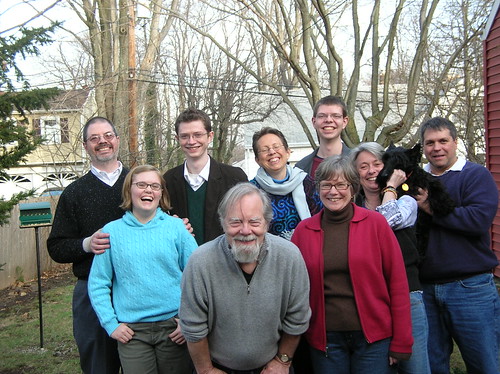
Pippa In Her New Dress

Hypothesis

OK, I think my understanding of what’s going on with my runaway osascript process has focused to a leading candidate: namely, a malformed or bugged cron job. Today’s question is, “Where do I look for the system crontab and for any user crontab that some application or installation might have constructed?”

Today’s Get-Together

We drove up to Greenwich this afternoon to visit my sister Holly and James, and my father and Susan. We took a complicated route over to Route 1, then from the GW Bridge to Greenwich, but it all worked out, both ways. We had a great time — Nate’s Laura learned a lot about my family history — even we picked up some new angles — we had a wonderful lunch, and trundled back home.
 

Family Get-Together

 
Tomorrow, Jeanne and Gail roll down from Maine, and we all head over to the Sully-Rohrer household for dinner.

Full Day

We had a visit with the Winter-Thurman family for which we cleaned up and made brunch, then some of us trekked into Princeton to resolve the Case of the Elusive Rutabaga (resolved), then back for dinner, and by this time in the evening we’re pretty exhausted.
 
Regarding rutabagas: It turns out that the hot gift item this fall was the USB turntable — a fact that I did not suitably appreciate, especially when I saw stacks of boxes of them in en electronics store a week or so before Christmas. Since we weren’t going to celebrate till the 26th, I figured I could pick up a turntable for Si on the morning of the 26th, at post-Christmas sale prices, and not have the box lying around the house for a week. Wrong! When I went through town yesterday morning, Pippa and I stopped in five electronics stores, none of which had any USB turntables left in stock. I finally tracked down a USB rutabaga this afternoon, and Si is happily listening to records on it. I, in turn, am awash with nostalgic reveries about the extent to which LPs and turntables defined a phase of my life. Now I wish I had stored those mountains of vinyl somewhere, instead of selling off Si’s birthright for a mess of pottage.

The Second Day

PIppa and I will soon leave to pick up Nate and Laura in Philadelphia, stopping en route to buy a rutabaga. After the travelers catch their breath, we’ll open the gifts that we ignored yesterday, and have our choir director over for dinner.
 
Briefly noted, then:
 
¶ A while ago, in the sad aftermath of Anita’s and Marc’s deaths, Dave Winer noted that bloggers risk disappearing from the Web once they’re no longer around to pay their hosting bills. Subsequently Tim Bray has weighed in with his very cogent thoughts on the topic. For the record, and since Dave is very exercised about keeping track of the historical record with regard to “firsts,” I blogged about this problem way back in 2003 — as Joi and David noted at the time. It even turned out to be the hook for my TV interview on France 2. So although I didn’t invent the Internet or blogging, my concern about archive death predates Dave’s.
 
¶ I don’t remember the chain of links that led to it, but yesterday I discovered The Head Lemur’s “new Greek” page of meaningless boilerplate prose to fill up a given text frame. He’s the guy behind pixelview.
 
¶ I frequently look for song lyrics online, a practice beset by dire danger of running into pop-up, pop-down, pop-behind, polypop, spam-infested traps. The safest site (I think) that I’ve run into is Song Meanings, which adds the debatable value of site members appending their interpretations to lyrics.
 
¶ Thanks to the remarkable Stephen Downes, I’ve been impressed by links to an open-source flight simulator, a concise demystification of how people learn online, and Stephen’s own thorough account of how creators benefit from freely-distributed work.
 
¶ I haven’t figured out how best to use it yet, but the Vatican’s Bibliaclerus site looks promising.
 
¶ I haven’t been really knocked out by the music releases of 2007; I’ll post a longer entry about the year in music eventually, but as I accumulate more and more digital recordings, I spend less and less time to listening to brand-new releases. For a similar reason, I hardly ever listen to “albums.” Off the top of my head (where hair used to grow), though, I can affirm my positive response to Springsteen’s Magic and to Lyle Lovett’s It’s Not Big It’s Large.

History Always Repeats

I admired Leah Price’s column in yesterday’s NYT Book Review; I tend to sympathize strongly with the retrospective historians’-eye view that the present generally thinks of itself as exciting and unique and unprecedented and ominous in ways that doesn’t square with careful attention to our ancestors’ experience. Price reminds hand-wringing doomsayers that “until radio and television dethroned the book, social reformers worried about too much reading, not too little.”

As Price points out, the internet has made readers of people who were significantly less likely to pick up a tome off the Nonfiction Bestsellers List. There’s a difference between reading online and reading books, but that difference can’t accurately be characterized as a decline in reading per se. If there’s a problem with what we read online, we need to address it by acknowledging first that we are online reading.

This exemplifies yet another dimension of my tedious refrain: We’re participating in (or “futilely resisting”) a cultural transition in response to digital technology. We can panic and shout, we can ignore it and hope it goes away, but the most productive course entails participating critically — so that we know what we’re pontificating about, and can make pertinent, useful suggestions about how things might be better.

Plus One

Josiah’s home from college, looking well and strong and tall. He and Pippa and I spent yesterday afternoon braving the wilds of Princeton-area shopping locations, looking to fill the holes in our gift-giving inside straights. We work well together, had a good time, and covered most of what we needed to.
 
We’re expecting Nate and Laura on the day after Christmas, and Jennifer will come home who-knows-when, but this townhouse that seems quite spacious when it’s just Margaret and Pippa and me will soon be brimful of family (and eventually we’re taking the show on the road to visit Holly and my Dad and Susan in a rented van).
 
As Maxwell Smart used to say, “And loving it!”

Whew!

The days are getting longer! At last!
 
Meanwhile, David’s description of the return of Open Source Radio gets it just right — “more naturally than ever, in Web-only form.” It hadn’t clicked with me before, but after Chris started his interview series as podcasts, something seemed off-kilter about his moving the show to radio.
 
There was something else I meant to link to. When I remember what, I’ll delete this paragraph.
That’s what it was! Jon Armstrong’s very clear, extensive description of what it’s like to live with a someone who has serious chronic depression. Add that to Heather’s own perspective, posted a couple of weeks ago, and you get a moving sense of what this life entails. My own experience differs from Jon’s — every depression is different, every spouse is different, every relationship is different — but these two essays convey a vivid picture of what your experience might be somewhat different from. For a variety of reasons, I’ve become a contact for people who need a crash course in depression and its ramifications; these are now highly recommended reading for that course. (I don’t require anything of anyone who’s coming to grips with this particular beast.)

Anyone? Bueller?

I’ve been watching my CPU load closely for the past week or so, and have noticed that some mysterious process occasionally takes over my processor and claims more than half of my capacity, and won’t let go. It involves AppleScript; the process is osascript, and it doesn’t make clear what launched it or what would complete it. Emory speculates that it’s a Folder Action, though I can’t think of a likely candidate (I haven’t set up any Folder Actions of my own, so it would be either an Apple-issued script or something that an application has installed. Any nominations would be welcome; in the meantime, I just watch out for it and kill it when it starts hogging memory.

Trends

I posted the separate videos of the Desperate Measures concert about two weeks ago, and it’s interesting to see how YouTube viewers have responded to them.
 
For instance, I gave “I Can See Clearly Now” a head start by posting it above the fold on my first presentation of concert videos, and it’s stayed near the top of the “most viewed” for most of the interval since then. But recently “Save Tonight” passed it for the lead in the “most viewed Desperate Measures video” derby (interestingly, two harsh critics among the viewers have assigned it a two-star rating). After “I Can See Clearly” in second place, there’s a sharp decline in viewing; “Zombie Jamboree” has half as many viewers as its heavier-hitting neighbors. “King of Spain” and “Torn” follow closely, with high ratings as well. Only about fifty viewers have watched “Brick” and “In The End,” but they liked them a lot (five stars).
 
I don’t have a far-reaching conclusion about all this, except perhaps that Eagle Eye Cherry fans are (a) curious about cover versions and (b) not wild about a capella arrangements.

Where It’s Happening

David links to the year-end summary of the favorite online videos from twelve webby marketers; I was delighted to see that he chose Michael Wesch’s “Web 2.0. . . The Machine Is Us/ing Us” (and Seth Godin chose Wesch’s follow-up video).

And Doc points out that David Isenberg has wrangled another year’s-worth of F2C, his annual “Freedom to Connect” conference. It’s a pivotal meeting at a pivotal moment in the trajectory of U.S. participation in cultivating the digital dimension of our common life, and I hope some legislative types (maybe even some candidates) pay attention to what develops there.

As Best I Recall

It will come as a complete shock to my friends to hear that somehow, between the study at home and my study at the Center (in other words in the short walk through the living room, out to the car, from the car in the parking lot upstairs to the office), I completely lost the manuscript for Sunday’s sermon. I have the computer file, of course — I just lost all the emendations I scribbled onto it as I read, reread, and improved it before the service. I’m pasting a version of it as best I can reconstruct it in the extended section.
 

Deb greets AKMA at her installation

 
And not only was Debra installed Sunday, but several of my Chicago-area students were priested: M.E., Susan, Heidi, Corinne, and Jeannie (and Janey, too, further afield). It was a busy weekend for the Holy Spirit!
 
Now, to square away some loose ends and finish our gift-shopping. . . .
Continue reading “As Best I Recall”

Pro Tempore

I know I promised to post Sunday’s sermon yesterday, but I’ve lost my hand-corrected copy of the manuscript. If need be, I’ll reconstruct the changes I made — but I’d rather start from the refinements I already made.

Dear Jeneane

[IF YOU CAME HERE FROM BOING BOING OR SLASHDOT, THE LINK YOU’RE FOLLOWING IS HERE.]

That rain you requested was sent to the wrong address.
 

I drove from Princeton to Cape May today, to preach at Debra’s installation as Vicar of St. Barnabas, a small church near the southern tip of the Jersey peninsula, and all along the way I saw standing water in streets and fields, streams brimming their banks, muddy rivers, flooded coastal swamps, and more coming down every mile. I wish I could redirect some of it where it’s more needed. . . .

The service, on the other hand, was wonderful — a community amply enthusiastic about their pastor, Bishop Councell demonstrative in his delight with Debra’s ministry, and generous good humor all around. I’ll post the sermon tomorrow; tonight I’m just unwinding.

Do I Read an “Amen”?

From Stephen Downes, a post from Michael Umphrey that emphasizes the importance of actually improving students’ writing (at the high school level — but gosh darn golly, maybe something like that would even help college and graduate students). Some of the standout points include Stephen’s comment that “I do believe that there are good reasons for good writing, and that there are ways to become a better writer. Clarity and precision – whether in writing, art or athletics – are virtues, because they help you obtain your objectives. The principles of writing are intended, in the first instance, to foster clarity and precision,”; Michael’s observation that although “empowerment, authenticity, and voice” may identify dimensions of writing that teachers should encourage, “research (not just Googling). . . . truth, and accuracy” were pretty desirable too (I would add “even more desirable,” and I’d import Stephen’s “clarity and precision” here. Plus, “knowing the difference between an argument and an opinion).”

Michael suggests that getting students to write online, where they stand visibly responsible for what they say, would be a good step — blogging, for instance.

Michael notes that you can’t simply assume that accredited teachers make good writers (one might think this self-evident, but the ideological power of credentials obscures the obvious in this as so many other respects). Teachers need to be taught to write better, and the whole curriculum should support the value of strong, clear, focused writing — otherwise, in a culture that accords little explicit emphasis to effective expression, it will be perceived as a cranky obsession of the minority who uphold it. “Promote this school as the place where writing matters.” In theological education, one can only imagine what would happen if a particular seminary got the reputation as forming remarkably articulate, effective preachers and communicators.

It’s not that it has been tried, and found wanting. It’s that it has been found difficult, and not tried.

Don’t Know What To Make Of That

As I was working on my sermon for Debra’s installation just now, I hit the Quicksilver launch combination to start my copy of Accordance, to fine-tune a biblical reference — and Warcraft booted up instead. Pavlovian creature of habit that I am, I began to enter my login and password before it occurred to me that this was not the application I wanted at the moment.

Debra need not fear; I will not be incorporating any dialogue from Warcraft in the sermon for the day (although one can allegedly learn useful life lessons by playing). Pippa wants me to discuss the theological proposition that “God is a chipmunk”; I’m not sure where she picked that notion up, or why she would want me promoting it, but such is the way of teenage daughters, I guess.

Much

It’s practically mid-December, and no one warned me. Something ought to be done.

I built a number of primitive computer games back in digital antiquity, I’m a gamer now, I’m an Anglican theologian, and was brought up in a Shakespehearean household. I would have given an eyetooth or two to be part of Edward Castronova’s Arden experiment, so you can chalk up some of what I’m about to say as sour grapes. But when (as it turns out) he was obliged to suspend development of the experiment because the game he produced “is no fun,” I think I am somewhat justified in saying, “Duh!” Castronova is a good guy and an acute economist, but from what I gather (“Arden” relies on a software engine I don’t have, and it’s not clear whether it runs on Macs at all), he seems to have built a world that’s functional and accurate, but offers players no persistent motivation for playing. Oh, well, what’s $240,000 among friends?

At the same time, Yale has used a grant from the William and Flora Hewlett Foundation to put put together seven complete online courses — one-upping MIT’s Open Courseware by heightening production values and rolling the whole course into the package. You can chew gum and stare down at your notebook in your own home (not for credit, of course), while prominent Yale faculty lecture through several popular courses. Props to Yale — it looks as though they’re doing this very right, and I’d advise anyone who’s thinking of going to seminary, or any seminarian who hasn’t already taken Old Testament intro, or anyone who’s in OT Intro now or needs a refresher, to check out Christine Hayes’s course. And bonus points to Yale because the course materials are all minty-fresh Creative Commons licensed!

Plus, Margaret flies home this afternoon! What could make the day better?