Spice
I love Glasgow. The bathroom scale in my flat reports my weight in kilograms and stone, but not pounds, so I can pretend that my weight bears no relation to the quantity of pounds that I know I really ought to weigh.
Ruminations about hermeneutics, theology, theory, politics, ecclesiastical life… and exercise.
I love Glasgow. The bathroom scale in my flat reports my weight in kilograms and stone, but not pounds, so I can pretend that my weight bears no relation to the quantity of pounds that I know I really ought to weigh.
In my on-going efforts to keep Margaret’s memories of Glasgow alive and radiant, I took a series of photos of signs between the flat and my office at the University.
• Nice piece from NPR about a neuroscientist who discovers that he is related to a number of notorious murderers, including Lizzie Borden — then learns that his own brain has several features associated with murderers. He is not a dangerous psychopath himself (so far), which he attributes to a loving upbringing. That sounds a wee bit simplistic to me, but I’m sure that having a positive childhood helps, and it seems likely to me that other elements, of which we’re not specifically aware, enters in as well.
• Google Books announced the release of a great many books for the study of classical languages (and they had already digitised many others). Tolle, lege!
• Wizzywig Comics’ Ed “BoingThump” Piskor posted an interesting display of comics frames that imply the passage of time within a single frame.
• World Cup? What World Cup? I don’t know about you, but I’m looking forward to the beginning of the preseason friendlies in the SPL.
• I uploaded some more photos of everyday sights from my walk to and from church, to help Margaret get by during the time till she can come over and join me.
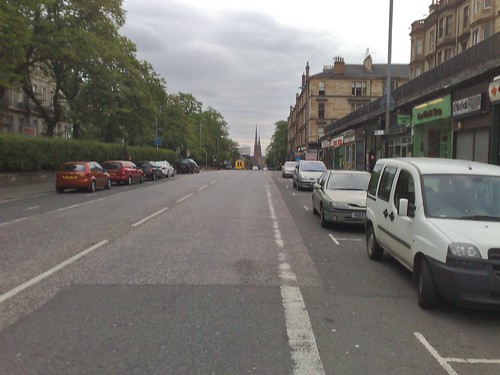
Although the weather was overcast Sunday morning, it’s generally been exceptionally marvellous for the past two or three weeks. I may take some more pictures today, to underscore the blue-skied splendour of summer in Glasgow.
• My clerico-academic colleague the Rev. Dr. Ralph McMichael has taken up the opportunity afforded him by budget cuts at the Diocese of Missouri (that’s the delicate way of putting it) to launch a Center for the Eucharist, whose mission aims at a renewal and deepening of the centrality of the Eucharist in the life of the church. I feel a little too far away to lend him full support, but those in range of Ralph’s base of operations would do well to keep alert to the various ways the Center might cooperate in strengthening their work — and in how they might srengthen the Center.
• Today’s post-grad graduation day, so that some of our friends will be receiving their degrees and moving on to What Lies Ahead. Cheers and congratulations to Alana, Mark, and Bryan.
• In connection with Neal’s hyperbolic (but flattering) characterisation of me as “high priest of rock and roll at #solasfest,” it’s worth a pointer to today’s Cat and Girl comic. Further, I notice that since I submitted my article on the Mountain Goats to its editor, I once again enjoy listening to them very much more.
Hey, Amazon, I’ll bet the demand for those St. George’s Cross-branded Flip HD cameras is going to drop off a wee bit now, isn’t it?
I woke up promptly yesterday morning, to head to church for Morning Prayer, whence Kelvin gave me a lift to the Solas Festival, where he and I were both on the day’s program. My talk was earlier, providentially scheduled against one by Richard Holloway, former Bishop of Edinburgh, Primus of the Scottish Episcopal Church, and well-known theological radical. I say “providentially,” since (after all) the hand of Providence must be at work in it some way, though what the eternal decree seemed to have in mind was “only a handful of people selecting AKMA’s talk rather than the famous rebel’s more bracing, controversial presentation.”
The presentation went well.

There were more than two people there once I started talking (“three” is actually 50% more than two — and the tent filled up with as many as seven people for short intervals. Of course, when these unwary passers-by discerned the decree of Providence, or perhaps just realised that this was the weedy theologian from Glasgow rather than the hot former Bishop of Edinburgh, they moved along.).
On a more serious note, I talked through my thoughts about an appreciative theological criticism of rock music, along the lines of waht I said at the SBL meeting in November. After I was through, Neal, Doug, Geoffrey Stevenson, and the gentleman from Third Way had good questions for me, and we talked things over for a while. I recognised that I had the essence of an article, and there’s no real reason not to take it the last few steps and find a place to get it into circulation. So that was good.
I took a coffee break and listened to Sol, the band of Rory Butler (who was in one of my fall semester classes). After Sol’s set finished, I wandered back to check in at Kelvin’s movie showing and presentation. That being done, we returned to Glasgow in time for me to watch Ghana trounce the USA in the World Cup.
Then this morning, I preached at the Cathedral. As usual, I stopped at the Bay Tree where I took a few minutes to work on a lectionary essay; then on to the cathedral, where the sermon went well. After church, I arrived back at the flat with time for a sandwich, a nap, and the very disappointing England vs Germany match. All this made for a weekend that was satisfyingly productive without being exhausting. And tomorrow’s Monday!
The other day I was in Marks & Spencer picking up biscuits for the biblical studies seminar tea, when the gent behind me in line and I both noticed this magazine. We stared somewhat incredulously at the cover, and wondered together whether there really was a market for Eulogy subscriptions.
I’ve written before about the importance of people really thinking through their relation to death (and to a culture that tries its hardest to suppress the inevitable reality of death). I’m just not sure this is a step in the right direction — giving death the Cosmo treatment.
I’ve sounded Google every few months for the answer to a question that has nagged at me for more than twenty years, and now I’m going to turn it around and leave the question on my blog to see if it turns up in the search results of someone else who knows the answer.
Back when Margaret and I lived in New Haven in the 80s, I listened to a gospel radio show on a community station (maybe “Gospel Express,” I’m not sure). One of the songs I heard that made a big impression on me was a mass-choir performance of a song whose refrain mashed up Psalm 34 with Hebrews 11:25. As best I recall the lyrics, they went something like
I’ve decided I’m gonna live holy
I’ve decided I’m gonna live right
I’ve counted the cost, made up my mind
I’m gonna live for Christ
Now living holy in this world means suffering
But that’s all, that’s all right
’Cause I’d rather suffer
I’d rather suffer the pains and afflictions
Than to enjoy the pleasures of sin for a season
I’d rather suffer the pains and afflictions of the righteous
If someone recognises this, I’d be tickled if you could point me to the source. Obviously the lyrics draw heavily on precedents from the Bible and earlier gospel figures, but I appreciated the choir’s performance, the tempo, the intensity of the lead singer, and overall effect of the scriptural/musical confection.
Ahead of the upcoming Scott Pilgrim Vs. The World movie, the publicity department has prepared another character generator (joining the Simpsons, Mad Men, and various others). You may want to shut down the volume before you hit the site and raise it carefully; the site soundtrack defaults to “on.”
Yesterday I was conducting some research for an article that’s been trying to force its way out of my head and onto pages. As part of that research — honest, really — I came across this video clip:
I asked Josiah if he recognised it, and he said no; I haven’t caught Nate yet. This is a Basque folk song that I used to sing for the boys when they were kids, to quiet or distract them. I learned it almost forty years ago when I spent a summer month studying in France, in St. Jean de Luz, at Lycée Maurice Ravel. M. Lavigne (whose name some of my Squirrel Hill fellow travellers pronounced “Levine”) introduced our class to various glories of French language and culture, but also taught us some Basque songs — including “Arrantzaleak” and “Kinkiri Kunkuru,” both of which I can sing to this day (allowing for some errors related to the fact that I do not know Basque).
I was chuffed to discover how well my memory had preserved the melodies and words of the songs. And if I had another lifetime at my disposal, I might add Basque to the queue of languages I’d like to learn (after improving my German and Latin, learning Gaelic, learning at least one Sign Language, probably Spanish, and I think there’s another I’m not recollecting).
Research for this topic complete, nostalgia satisfied, back to writing.
A year ago today, I was interviewing for a job on Pluto. At least, that’s what I let out on Facebook (the “Pluto” part was an inspired idea of Pippa’s); terrestrial observers might have seen me wandering in a spaced-out, jet-lagged, delighted, anxious sort of way through the streets of Glasgow’s West End. I explored Professors’s Square, especially Number 4, and meandered up and down Byres Road. I marvelled at the sunny weather — not at all what I’d been told to expect in Glasgow — and the long, long summer days. (I did not take time to think about what that implied for winter days.)

After I gave my presentation to the department, and then had my interview with the search committee, I made my way back to the B&B at which I was staying and laid down stretched out for a nap. Late in the afternoon, I got a phone call saying that the committee would ask that I be appointed to the opening. I was dazed; I was joyous; I was exhausted. I went over to Yvonne Sherwood’s flat (just around the corner, as it turns out, from where I would live), and she and a couple of my new colleagues welcomed me and celebrated with me.
It’s been a hard year, living apart from Margaret yet again. It’s been a very full year, stumbling through my introduction to an educational system so similar to the US on the surface, and so very different from the US in all the details. It’s working out well here, though, and I’m beginning to feel at home in the department Subject Area, and I’m looking forward to getting acquainted with my new colleagues in the School of Critical Studies. I joined the union as soon as I got here, and this spring we’ve authorised a strike to protest compulsory redundancies in three areas of the University — and yesterday the University Court decided that they would not impose any redundancies. And both England and the US won their World Cup games.
Margaret and I are heartsick about the complications that have delayed her joining me here; she asked me for photos of our walking path to and from the department Subject Area offices, so I took a small mountain of pictures to illustrate the Flat-to-Square axis (start here and browse toward the right for the trip to the office, and start here and browse toward the right for the trip home. Paths are not direct; I make a couple of side trips to incorporate sites Margaret would recognise. And there are some campus- and union-related photos in the middle). We wish Glasgow were closer to where our fantastic children will be living, and there are some other hardships about this relocation. But this has been a very wonderful year, in which neighbours in the University and St Mary’s University (and at other universities and the Scottish Episcopal Church) have reached out and embraced me in a quite unexpected way. It’s all a tremendous blessing, and I’m intensely thankful (and just imagine how thankful I’ll be once I’m reunited with my beloved).
The Anglican chaplaincy’s contribution to the West End Festival here in Glasgow was to offer a continuous reading of St John’s Gospel from the Authorised Version (King James Version) of the Bible. Seven readers — this blogger included — processed into the University chapel, stood and sat for twenty-one chapters, and proclaimed the Johannine gospel for the dozen patient listeners who attended the reading in person, and for the (no doubt innumerable) online viewers who looked into the University chapel webcam.
The reading went well. Each of us, I think, slipped up on word order occasionally (I know I did); it’s extraordinarily difficult to maintain the Jacobean word order for negation and copulation, even after rehearsing, even when you are looking directly at the words in question. Some “you” for “ye” (or vice versa), some coughing, and so on — but no fumbles as disruptive as, say, Robert Green’s blunder. I’ve said for ages that the New Testament texts benefit from being heard straight through, and last night that certainly proved true for John’s Gospel.
Plus, Oxford University Press evidently heard about our special event and sent us seven copies of the KJV from their “World’s Classics” series. I can’t wait to read through and find out how the story ends!
After a half pint with other readers at the Ubiquitous Chip, I strolled home and fell asleep. This morning, after I post this, I will head back to the Uni to join my union colleagues in protesting the Principal’s plan to lay off teaching staff in Life Sciences, Education, and Archaeology (archaeologists, represent!). Then, of course, I’ll hurry home to watch the US and England football games. With the weak quality of some of the teams that qualified, it’s extra sad that Scotland and Ireland (in a sense, Ireland especially, because the discordant French team qualified at Ireland’s expense on a hand ball) couldn’t qualify too. I’ll be rooting for Ghana, the only African team left in the mix; if they’re eliminated, I’ll have to reassess and choose a European or South American team. (I’m assuming that even if the US or England make it into the knock-out tournament, they won’t last long.)
Off, now, to demonstrate my solidarity with Indiana Jones and the biologists and education faculty. . . .
The General Synod of the Church of England will consider a report on its ecumenical relationship with the Church of Scotland (the CoE is established (entangled with the government) and observes an episcopal polity (government with bishops) whereas the CoS is a national church (largely disentangled from government) and observes presbyterian polity (government with councils of elders)). That is all to the good; the relationship of these two ecclesial bodies has long been vexed, and rapprochement would count as a very good thing.
On the other hand, the report in question minimises — almost ignores — the relation of these two dominant groups to the middle term, the Scottish Episcopal Church (and I suppose it ignores English Presbyterians, too). Speaking as a newly-minted Scottish Episcopalian, I find it disquieting that the two dominant bodies enter into negotiations that bear so forcefully on the identity and well-being of another province of the Anglican Communion, another Christian body operating within Scotland. The report does advise that “The Scottish Episcopal Church should be involved forthwith,” but through the seventy-one pages of the report, the SEC might as well not be there. We get the most coverage for our participation in the Scottish ecumenical discussions of recent years (the Scottish Churches Initiative For Union, from which the Church of Scotland withdrew in 2003, and Episcopal/Methodist/United Reformed ecumenical dialogues), but the report makes no reference to the Church of Scotland’s attempts to restrict and suppress the Episcopal Church.
I have no interest in belabouring contemporary Presbies for the penal codes of their great-grandparents, but am disappointed that Scottish Episcopalians seem to be only an afterthought in this document that concerns them so intimately. (Hat tip to my boss at St Mary’s, and to Simon Sarmiento for the link to the report.)