Hello, My Name Is AKMA

I haven’t forgotten you; I just had a very busy run-up to the Society of Biblical Literature meeting, was busy at the SBL (presented two papers, chaired three sessions, various committee meetings, etc.), then came back to a challenging metabolic shift and a stack of essays that awaited marking. I’m on the verge of finishing up the essays, I have some emails to write, notes to hand-write, a handout to complete, and some last-week-of-classes obligations. But lo! It is in fact the last week of Fall Semester classes, I’m near finishing up my obligations, and I’ll have a little breathing room to take stock and figure out how to adapt better in the spring.
 
I plan to post the papers I gave in New Orleans, but they need massaging first.
 
Today is Pippa’s birthday, which makes me proud and happy.
 
Margaret and the kids (including Laura and Laura, but not Jennifer) got together in Ypsilanti for Thanksgiving, and had a great time. We had a group video-chat which permitted me to see PIp make moose antlers behind Margaret’s head, and to say Hi to the couples. Hey, and they all went to see David Archuleta at the Ann Arbor Symphony Orchestra! My informants suggest that the Ann Arbor reviewer was charitable, but the comments to that post incorporate so many words in all caps, and so many exclamation marks, that my informants must be underestimating this EXCELLENT talent, the REAL DEAL!!! (I have never, so far as I know, heard Mr Archuleta sing anything, so I have no opinion on the topic.)
 
What else? Surprise kitten really is sweet and amusing. Jeff Jarvis’s take on “post-media media” rings true to me. Oh! And the Velveteen Rabbi and EthanZ are parents — so excited for two three lovely, sweet people. Congratulations, Drew! (Excellent name, by the way.)
 
Time to square away the last essays…
Presentation Playlist

As I’m giving a talk Monday afternoon about the relation of theology to rock music, it’s only fitting and appropriate that I forestall workin on it by putting together a playlist of the kinds of song that particularly interst me as a theologian. I’m ruling out U2 and Bruce Cockburn at the outset, not out of distaste but because they’ve been the focus of a lot of theological spotlights. I’d rather not pick performances that ordinarily would be recognized as straight-ahead gospel (though I may be soft on that judgment). My favorites for this exercise invoke, or flirt with, or hint at theological themes without coming out and clobbering you over the head with them. Or if they do make the theological motif explicit, the selection in some other way inflects the overt theologizing with a less straightforward nuance. Or, maybe I just like it, so there.
 
What I’ve got in the playlist right now is:

  • “Cobra Tattoo” by the Mountain Goats
  • “And A God Descened,” by Dar Williams (most of The Green World would fit this list)
  • “How a Resurrection Really Feels” by the Hold Steady
  • “We Walk The Same Line” by Everything But The Girl
  • “The State I Am In” by Belle and Sebastian
  • “Holy Spirit” by Michelle Shocked
  • “Jesusland” by Ben Folds
  • “Something Beautiful” by Sinead O’Connor
  • “Way Down In The Hole” by Tom Waits
  • “Get Up Off Our Knees” by the Housemartins
  • and “Thunder” by Prince, which gives my talk its title (“C’Mon Save Your Soul Tonight”

 
I’ll think of more — always working on gender balance, and I have to put them in order — and I might slip in George Harrison’s “All Things Must Pass” to honor Dale Allison’s paper on George in the same session, and maybe a hiphop selection to honor Valerie Bridgman’s paper (“Jesus Walks” would be obvious), but for now that’s it.

Missing

D’you know of whom I want to see more in this concluding season of LOST?
 
Mr. Eko.
 
I’m tired of Jack and Locke and Ben, Kate’s beginning to wear on my nerves, and many of the rest of the islanders have worn out their welcome — but Mr. Eko had a strange backstory, he was a cool character, and his death left a variety of dtails unresolved. Bring back Mr. Eko!

Lucy’s Right

Lucy Knisley gets it just right: Books are precious and wonderful, but it’s the wrong idea to try to smother the digital baby in its crib — that only makes for vengeful survivor-adolescents, and it’s bad for the soul of the smotherer. Digital texts offer advantages that print media don’t. We should be concentrating on ways we can take full advantage of (and improve!) digital media, and those of us who still want books can by all means keep buying and collecting books.
 
Suw and I were tweeting back and forth yesterday about this general topic (tweets edited for format, not content):

Suw: still makes me cross that museums like V&A aren’t putting images of paintings they hold, e.g. from 1806, into public domain.
AKMA: @Suw There’s a great contribution to be made by some fndtn underwriting good, reproducible digital versions of pub[lic] dom[ain] texts/images/music.
Suw: @AKMA I could not agree more. I understand museums need to make £££ but they should be adding value, not charging for basic image.
AKMA: @Suw “Adding value, not restricting access” = FTW. Artificial scarcity is a losing tactic.
Suw: @AKMA absolutely! well, we’ll just have to show them how it’s done. 😀

Now, I already thought the world of Suw, both from converations in olden online times and from when she was so tremendously kind and attentive when I learned about my father’s impending death at Freedom To Connect last year (it seems so long ago!). I’m impressed with (and keeping an eye on) her start-up, Book Oven. And she too sees that the rearguard action of trying to prevent the future only costs the publishing industry money, delays its acclimatization to the present, and frustrates and alienates some of its pivotally-important customers (to wit, the digital natives who populate Scribd and other such havens of PDF-downloadable goodies).
 
There’s no way to come out ahead by resisting digital media — at least, not once you factor in the hidden costs of continuous on-going security r&d, lawyers, damage to reputation/good will, alienation from tomorrow’s mainstay buyers, and so on. I used to irritate students in my language classes by urging them to let Greek teach them Greek — that is, by reading along and observing what Greek authors actually do with the language rather than by ingesting a bookful of rules and definitions that the authors may never have heard of, and expecting the texts we read to be controlled by the rules. So too with digital media: sooner or later, the publishers and distributors will have to let digital media teach them how to prosper in digital publishing. Cory Doctorow and Radiohead have shown that freely-distributable works do not equal “no payment for creators.” Artistic creation didn’t begin ex nihilo when copyright was legislated, and it would continue (in different ways) if copyright were absolutely abolished. But since no one, so far as I know, is suggesting that copyright be abolished, why not step up and meet the future on the future’s terms? Why not use digital media for what they’re good for, print media for what they’re good for, copyright law for what it’s good for, and unleash a lot of imaginative energy that’s been pent-up by lawsuits, rootkits, nostalgic anxiety, self-protective lobbying and legislation (what Cory and Doc called the Anti-Mammal Dinosaurs’ Protection Act).

Sundry Stromateis

  • The NPR Fifty Top Recordings of the Aughties series covers a great deal of excellent music, calls to my attention some items I had neglected, and (of course) omits plenty that I’d have included. As is always the case, the point of a Top X list is to get readers arguing among themselves, so have at it.
  • I tend to dislike discussion forums, but Dooce’s newly-instituted forums include two recent topics to which I wanted to link. The first is the question about memorable matches between movie scenes and soundtrack music; the second is the topic “How do you react to a public toddler tantrum?”, to which I respond by linking to this ad from UK television.


    Not that I approve, of course, but (a) the mom’s appearance reminds me of a student I once had (don’t remember which); (b) the reaction shot of the formerly-tantrumming kid is terrific; (c) the mom’s expression and gesture to the kid after her tantrum are spot-on. Been there, haven’t done that.
  • I mislaid my calendar. I do that every time I try to keep a calendar responsibly. I hate it when that happens.
  • Rocker/theologian/designer Michael Iafrate has a sister Janet who published an article on Harry Potter and peaceable resistance. Well done, Janet!
  • The Bishop’s Office has contacted me; I have a “Permission To Officiate” license, so if you’ve been biding your time, waiting for me to perform some sacramental action, now’s your opportunity.

Full Day

This morning, I hurried downtown to meet with the Dean of the Diocese of Glasgow and Galloway (the episcopal see is vacant for now, and the diocese is led by the Dean, who is not (as in US polity) the “rector” of a cathedral, but is a senior cleric in the diocese; the cathedral’s senior cleric is a Provost). We had a convivial half hour’s conversation, at the end of which time he deemed me safe to turn loose upon the diocese. I hastened from there back to my office in time to greet several students (I’m in charge of signing requests for extensions for the department, and right about now that makes me the object of a lot of attention), have a quick conversation with the Head of Department, grab a bite of lunch with a neighboring scholar, connect with a student to talk over the preceding assignment and discuss the next, scramble to class (where I could be in the same place addressing the same topic for two blessed consecutive hours), headed back to the office to gather my paperwork for home, and stride purposefully back to the flat.
 

Fox Eyes

 
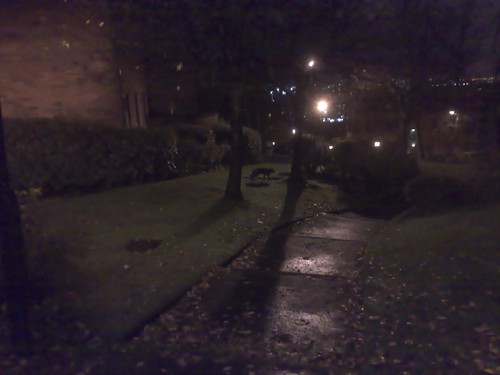
At the entranceway to the block of flats, I saw (for the third time) a fox. Evening had already fallen, so I had only the illumination of the light pole, but you can see the fox’s eyes reflecting back at me from the bushes.
 

Fox and Shadow

 
And then he scampered away, perhaps to besiege the neighbor’s last remaining chicken.

Round 4: The Seventies

In this week’s Sesame Street video voting, Kermit’s “Bein’ Green” should be a lock to walk away with honors, but I was never that crazy about it. Second place will go to “Rubber Duckie”; I think I have to cast my vote for Ernie, though it’s tough to bypass the earworm “What’s The Name of That Song?” Cookie Monster’s version of the “Theme from Shaft” rocks; Big Bird’s “Alphabet Song” is a delight, and “Everyone Makes Mistakes” serves a useful pedagogical purpose; I’ll never get the Ladybugs’ Picnic” out of my head (“They talked about the high price of furniture and rugs / And fire insurance for ladybugs”). I’ll go cast my vote, then check the leaderboard.
 
(Missed my guess; “Rubber Duckie” is currently leading, followed by “Bein’ Green.”)

Isabelle Tuttle DeWitt

Most of my relatives are gathering in New Haven this afternoon to pray and sing, to remember and give thanks for my aunt, Isabelle Tuttle DeWitt. My feet are planted squarely in Scotland, but my heart aches to be with my family at Trinity Church on the Green: to recall my elegant, dry-witted, steadfast, generous aunt; to support Margaret and my sister and cousins, and to lean on them for support; to share with Holly and Margaret in representing my mother at the service, and in the gathering after. Ninety-nine days out of a hundred, I’ve felt all right about being here in Scotland. This morning I felt all right about being here. Tomorrow I’ll feel all right about being here. But tonight, as people are bustling around the church, meeting up at designated points, making their several ways to the center of the city where my mother and my aunts grew up — tonight I wish I were back in the USA, doing what family does.

Great Moments In Teaching

At the mid-class break this afternoon, one of my students said, “When I was reading the Mishnah at lunch time — as one will do — I noticed….”
 
That was great, and I thanked her for making my day. Then she continued, “I noticed the saying, ‘Laughter and levity lead to lewdness.’ ” That impressed me, too. Then she said, “That’s my plan for the weekend.”

Limp Cuffs

I’ve been to two cleaners in my neighborhood already, and neither of them offered the option of starching my collars and cuffs. What’s with that?

Solidarity

I heard the rumblings about job cuts at Francis Close Hall of the University of Gloucestershire a while ago, and in this case — in contradistinction to the case of Sheffield — I didn’t leap into action right away. I didn’t recognize the scholars’ names that protesters were invoking, and I acknowledge that sometimes institutions encounter crises that require job-cutting. Closing down the Biblical Studies program at Sheffield struck me instantly as a case of cutting off your nose to spite your face; it just couldn’t be that Sheffield, or any other institutional custodian of so outstanding, so distinctive a program, would be well-advised to axe that scholarly cedar. But out of fairness, I wanted to hold open the possibility that FCH was a different kind of situation.
 
But I am, after all, a union guy, a proud (that’s pronounced “prood”) member of the University and College Union, and I don’t want to neglect my colleagues in Gloucestershire. I hadn’t realized that Andrew Lincoln had moved there, for instance; it doesn’t sound that his job is imperiled, but my acquaintance with Andrew piqued my interest in the case. UCU submits that the problem in Gloucestershire arises from mismanagement, and that hard-working scholars’ jobs should be protected; that’s the vexing problem in such labour cases, where the institution’s large-scale losses from poor management decisions oblige the productive workers to pay the price. The reports at the Facebook group page suggest the same picture. On one hand, one can’t with the wave of a hand erase the vast deficit that management has accumulated; on the other, the institution will have a vastly harder time recovering without the benefit of the staff who make it an attractive venue for students. It’s hard to imagine that FCH or the Open Theological College will be strengthened to build up their revenues by dismissing Lloyd Pietersen or other staff.
 
So I’m about to send a stern demurrer to Paul Bowler at the University of Gloucestershire; late and dire as the situation is, it’s not Lloyd who should be liable for the budget shortfall.

Music For Money

NPR’s Monitor Mix blog has posted a great interview between Frannie Kelley (the interviewer) and Eliot Van Buskirk and Jay Sweet. Just a few of the bulls-eye, dead-on quotations:

FK: Right, so why are labels still making CDs at all?
EVB: Partially, it’s because they bought out their distributors in the ’80s. They literally own trucks.
JS: Exactly. And also because they need to have some payable against the bands, and they own the manufacturing, the distribution, the marketing etc.
 
FK: Does the money the average consumer spends on extras (like exclusive tracks) and novelty items, like the AC/DC amp, ever make it to the musicians?
JS: In many ways artists would be better off getting a straight loan from a bank.
 
EVB: Right, which it sort of is. As a wise man once said, if you want to see the best on-demand free music service in the world, go to YouTube and close your eyes.
 
EVB: The anger towards the major labels is well-deserved. They are the only industry I can think of that openly scorns, disrespects and tries to fleece their audience at every turn.
 
JS: If both the artist and the fan feel ripped off . . . that’s a harbinger of doom if I ever saw one.
EVB: I spoke with an RIAA executive around the time of the original Napster lawsuit, and his tone was very much “these goddamn meddling kids” and not “how can we treat our consumers better so they don’t backstab us?”
JS: The fans as the enemy is really a fight you can never win. Ever.
JS: Imagine any other industry where the brand sues its customer base on a regular basis.
JS: Pretty soon you go for a different brand.
 
JS: Smart bands have great management. Great managers have even better accountants.
 
EVB: Labels have essentially become banks. Radiohead’s genius with In Rainbows’ was, in part, to use a bank instead of a label. Banks have better terms, assuming you’re an established act like they are.
JS: Exactly what I said earlier.
JS: Bands would be better off taking out small loans than using a label.
JS: At least they would be in charge of their own accounting.

Nick Lowe was on the right track. But it’s well worth reading the whole interview. Well done, NPR!

Glasgow and Me, Addendum

I remembered one item I’ve meant to include in my relocation posts: Since I’ve arrived in Glasgow, I’ve walked past a couple of cars that had flat tires, and yesterday morning I heard at least one car coughing and sputtering as its owner tried to induce the motor to turn over.
 
That won’t happen to me for the foreseeable future. I won’t fill a tank with petrol; I won’t have to remember to have my car inspected, or to buy and display my parking permit, or find a parking space. I won’t have any fender benders, and I won’t have to worry that a moment’s lapse of attention might cause costly damage. Yes, it would be convenient to be able simply to drive wherever I want; but I’m happy for now to forgo those conveniences for the pleasant knowledge of all the expenses I avoid (and of my greatly diminished carbon footprint).

Glasgow and Me, Interlude

I finished a batch of papers today — a very small batch, compared to many of my colleagues around the world (I’m especially attuned to this, since Margaret probably grades more weekly quizzes and exams than I mark in a semester) — but learning the standards in each new institution involves a complicated exercise in imagination, listening, estimating, truth-telling, and (often) allowing mercy to triumph over judgement.
 
My task this time was facilitated and complicated by the impressive array of grading tools that the Department provides for its students. “Facilitated,” of course, because the more data concerning what makes an “A” an “A” (or “First Class Honors,” or “20 on a 0 – 22 scale”), the more effectively one can communicate with students, colleagues, and other interested parties. “Complicated,” because the Department provides at least three distinct sets of explanations of our (three different, but coordinated) scales of evaluation.
 
So a great part of the process involved trying to compare the different sets of evaluative explanations with one another, so that I could compare the actual essays to the characterizations my students get. I wound up making a big matrix of rows of categories of evaluation (given in one of the sets of description) crossed with columns for Excellent (A, First Class Honors), Very Good (B, Upper Second Class), Good (C, Lower Second Class), Adequate (D, Third Class), and Weak/Poor/None. I put descriptive phrases, greyed slightly, in each of the first four columns and left the last column blank for my own explanation of what was so lacking.
 
I still had to assign marks on a 1 – 22 scale to each paper, but between my on-paper comments and the tick marks in the matrix, students ought to have at least a foggy sense of how they could do better. The whole thing reconciles, generally, with the three fuller descriptions that the Department provides, and I have the comfort that my marks bear a more-or-less direct relation to what I (and we) indicate in our guidance material. And I won’t have to do that again next time, thank heaven.

Glasgow And Me, Part Three

This is the weather they warned me about. It has been rainy, grey, and chilly almost continuously since last Saturday afternoon. Throw in the shortness of the day, and the resulting atmosphere is relatively gloomy.
 

Clouds

 
But if this is how Glasgow gets its exquisitely rich greenery, and if the short winter days mean short summer nights, and it took two months of my residence to get a week-long string of cold, rainy days — that’s not bad. The rain’s supposed to dry up over the weekend, and a few days with no precipitation will be a good thing. The fallen leaves are dissolving slowly into a slippery cellulose goo that I’ll be pleased to be rid of. But I like Glasgow, and this weather is part of the deal. (Also, I should remember to goose up the heat in the flat, but not till I get back from my Saturday morning cup of coffee.)
 
I’m getting used to traffic on the left. When I arrived, my reflexes made me look for traffic on the US sides of the street, even when I knew that the traffic would be coming the other direction. My operating premise was, “There’s a car headed toward me, but I don’t know where it’s coming from.” I must have been a spectacle — even more than usual — flicking my head one direction, then the other. After a while, I’d get to the street, stop and think, look in the UK directions, take a quick look around to make sure there wasn’t a vehicle coming from an unexpected direction, and then cross. Now I’m pretty good at just looking in the needful directions.
 
I’d be pleased to find a restaurant that served a varied menu of vegetarian-friendly fare (in other words, maybe a gluten-free entree or two). The prominence of meat (and carbs) in Scotland’s diet impresses me.
 
No glitches in my bank account for the past few weeks. I realize that that shouldn’t be a big deal, but after the headaches getting it started, I’m not taking this for granted.
 
Oh, and speaking of things getting sorted, my landlord came by last week and saw to the joiner’s putting a new lock on the door. To my utter delight, the lock and key work very smoothly together, so I can walk up, unlock the door, and proceed directly into my flat, instead of arriving at my door and spending an awkward minute or so trying to negotiate with the older lock over whether I deserved to be admitted. Opening a door is not usually counted a particular delight, but I’ve felt a small surge of satisfaction each time I walked up to the door and simply opened it.
 Hmm, maybe I’ll add to this list if I think of more updates, but it’s getting late for me to head to Byres Road for coffee.

No Surprise Here

Inside Higher Education reports that faculty/teaching staff members think they’re pretty darn hip when it comes to technology — and students call their bluff, noting that “when students were asked about the top impediment to using technology, the top answer was ‘lack of faculty technology knowledge.’ ” It would be tough to come up with a more concise, acute account of the problems of enhancing technological support for teaching; throw in “shortage of funds,” and you can explain a lot.

Cheers And A Hat Tip

The University of Glasgow IT department keeps our Net infrastructure hypersecurely walled off from the big, bad, wild Outside World (here be worms, phish, and pirates!); I get frustrated several times a week at the relatively simple web operations that either can’t or won’t be done. In a somewhat bleak institutional IT landscape, though, the library staff is very active online, with their own WordPress blog and Flickr photostream (please CC license the images!), on top of a vigourous Open Access initiative. No surprise that librarians are leading the way; I’m going to have to make some friends across the street.