Marginal Stromateis

•   I’ve lived in several locations with low railroad overpasses (Evanston, and I believe I recall having encountered overpass problems when I was driving a furniture installation truck in Maine), but I was particularly delighted to see Durham foregrounded as a site for unfortunate truck-overpass interactions in this YouTube clip.
 
•   I loved the colouring-book comic frames of Hipster Dinosaurs to which Scott McCloud pointed the other day.
 
•   I had a great time at Scott Pilgrim vs. The World Sunday evening at the Grosvenor. Edgar Wright couldn’t have done a much better job of communicating the experience-world of arcade/video/computer gaming in a cinematic idiom; the actors handled their roles harmoniously (I keep thinking “So-and-so was so good in the role of [Character],” but I think that for practically every character); the film used its music-culture ambiance effectively; and the very light plot managed, by not over-reaching, to makes its point more satisfactorily than most movies that take themselves more seriously (even the ones that strive to wear their seriousness with hipster irony). Michael Cera in the lead role was perhaps the least satisfactory element of the production, which I say not to deprecate Cera but to note that his being recognisably “an actor” constituted a faint blip in the imaginative world the movie conjured. (I hope his voice changes someday, too.) I kept wanting to use the word “brilliant” to describe the film, but that’s too ponderous a characterisation; “pitch-perfect” or “just right” might be more apt. If you don’t care for or about comics or gamer culture, the movie may be too slight for you — but even if you only like a finely-crafted young romance (and don’t object to the comics/gamer idiom), Scott Pilgrim is worth a date. (Or Knives. Or Ramona. Or Wallace. Or… well, you get the idea.)
 
•   The Arcade Fire’s “The Wilderness Downtown” performs an amazing feat with Google Maps and streaming video. Since I grew up playing in the (relatively traffic-free) street in Pittsburgh, the effect was all the more striking — but seeing my old neighbourhood integrated into the video as the Project does gave me shivers.
 

Joy Doth Wait

I did mean to post Sunday’s sermon yesterday; I just ended up in two committee meetings that ran much longer than I expected, and then after I strolled home and made dinner I remembered that I was supposed to go to the Monday evening Bible Study at the cathedral, so I dropped everything and dashed to church. By the time I got back and chatted with Margaret, I just wanted to go to bed.
 
It’s now only a few days till Margaret will arrive. I need a sermon for Sunday, and I have a series of administrative obligations to fulfil this week, and I haven’t even opened the file for my James commentary for two weeks (augh!), and I need to clean house for Margaret’s arrival — but the weather is lovely, I’m gratified that my colleagues respect and trust me with responsibility after so short a time in this new system, and above all, I’ll be together with Margaret in less than a week!
 
Sermon in the “more” link below, or you can watch the video over at St Mary’s.
 
Continue reading “Joy Doth Wait”

Going To The Chapel

I’m on my way to church this morning, and the weather couldn’t be more lovely. My Sunday croissant and coffee are delicious, the sun shines gloriously, and I have time To sit and give thanks before I have to get vested and preach. Only one thing could make this better — and Margaret will be joining me here in just a week.
 
The song suggests that once one goes to the chapel and gets married, “I’ll never be lonely, wo-oah.” (Or “no more,” I’m not sure.) That turns out to work better as a lyric than as a rule for marital expectation. But all hard things must come to an end, and in just a week “I’ll never be lonely no more” — at least for a while.
 

Unsuitable

May I say that every day I see men in Glasgow who are stouter than I am, and (although I’m taller than most Scotsmen) often enough see men of about my height? I’m not so unusual in my dimensions, honestly — just a tallish fellow who’s gone a bit round in the chest and middle. But judging from the charity shops, it is only short, skinny men (or occasionally men of about my jacket size, but with short arms) who give over their castoff clothing. Somewhere there must be a vast warehouse overflowing with suits and jackets my size, but for now, second-hand clothing is only for the slender shorter men.

Neither Inventor Nor Bomber

A couple of days ago I noted that Andrew Adam had invented a sort of fencepost in 1904, but that I am not that guy; he lacked the distinctive “Keith Malcolm” that makes a mere “Andrew Adam” into an “AKMA.” Today, I learn that Andrew Adams of Swansea, Wales, is in the headlines because Boots the Chemist sent him a gift card with the identity line, “Dr. A Suicide Bomber.” Most readers will understand that Mr Adam was displeased by that form of address. “I’m not a doctor and I’m certainly not a suicide bomber.” Nor, I must add, is he Andrew K M Adam of Glasgow, who is not a suicide bomber, not a fencepost inventor, not even a lorry driver — but is a least a Dr.
 
So if Boots has a gift card going begging, I’ll take it.
 

Here, Here

I’ve been scrambling around to put together reading lists for my courses (and my portion of other people’s courses) this fall, which involves interacting with the online repositories of journal articles — an obligation that rivals for sheer ecstatic titillation such enviable pursuits as root canal surgery without anaesthesia, writer’s block, and listening to Vogon poetry. Not only are the interfaces for the various vendor packages all different; not only does each permit or discourage different ways of browsing; not only are they discontinuous with one another, so that if your library’s subscription to Transmodernist Hip-Hop Quarterly via JORTS expired in 2007, you have to navigate over to the Humanities Periodicals Database to pick up the 2008 issue for which you were browsing; not only do years sometimes disappear mysteriously from the range of “subscribed” volumes; not only do the URIs represent case studies in absurdly overcomplicated information design (here’s a no-kidding actual URI I was working with today: http://find.galegroup.com/gtx/infomark.do?&contentSet=IAC-Documents&type=retrieve&tabID=T002&prodId=EAIM&docId=A224406300&source=gale&srcprod=EAIM&userGroupName=glasuni&version=1.0); but (as Tom diligently reminds us) these soi-imaginant founts of knowledge operate principally so as to prevent access — first of all to the total outsider, but also to the academic subscriber who seeks knowledge in the wrong way (that is, a way that the database manager didn’t foresee, or foresaw and nixed), and then to the academic subscriber who’s in the wrong place (at home, rather than at a campus terminal), students likewise. In short, the role of the periodical-database companies is to prevent pretty much everything that a print librarian facilitates. Welcome to the awkward zone between the beginning of the digital transition and the time rationality sets in.
 
Anyway, my point wasn’t that I was disheartened by my travails with digital periodicals’ interfaces, but that despite the frustrations attendant upon such endeavours, I have greatly enjoyed my day in the office. I can’t overstate my deep satisfaction with my staff neighbours, with my students here, with Glasgow, with my work of teaching and administering and planning and researching and writing.
 
Now, if only I had time to do it all.
 

A City Neither Knows

Yesterday, a circle of friends gathered for a sort of combination leave-taking and blessing for Alana and Mark. We prayed and listened and gave thanks and watched Mark struggle valiantly to cast on, and to consume mass quantities of exquisite goodies.
 
They asked me to read a poem, which I gladly agreed to do. Much to my relief, they asked for a particular poem, and it was one I didn’t know very well — which minimised the risk of this very sentimental ageing man choking up while he was reading. Even when not reading aloud at some momentous occasion, I can’t get through Alice Oswald’s “Wedding” without a struggle against as upwelling of emotion. The poem they asked me to read — Anne Michaels’s “Into Arrival” — appeared to be relatively free of the triggers that might render me a weepy blob (rather than the deep-voiced, articulate reader one might hope to be).
 
That was “at first glance.” As I read it over and over to soak up its rhythms and pauses and emphases, it dawned on me how intensely it evoked the beauty of intimacy, and how it alluded to Alana and Mark’s own situation (they depart for a year in Jerusalem in a few days). So I spent the morning yesterday going over and over the poem, trying to make it so familiar to me that I could push forward through any surges of choked-up-ness. (That only made me more acutely aware of the poem’s beauty, which wasn’t as helpful as it might have been.)
 
When it came my turn to read, I launched in, and after a few lines noticed a difference between the printing in the copy I had been handed at the beginning of the service and the text I had printed for practice. This was a great blessing, because from that point onward I was concentrating on reading what was printed in my hands, rather than allowing my feelings to rise to the fore. I thus escaped the fate that actually befits my current state, eagerly awaiting the arrival of my own beloved Margaret in ten days — not the best frame of mind to be reciting a subtle poem of love on behalf of my friends.
 
Anyway, because I had not known it before, some of you may not know it —
 
====================
 
“Into Arrival”
 
 
It will be in a station
with a glass roof
grimy with the soot
of every train and
they will embrace for every mile
of arrival. They will not
let go, not all the long way,
his arm in the curve
of her longing. Walking in a city
neither knows too well,
watching women with satchels
give coins to a priest for the war veterans;
finding the keyhole view of the church
from an old wall across the city, the dome
filling the keyhole precisely,
like an eye. In the home
of winter, under an earth
of blankets, he warms her skin
as she climbs in from the air.
 
There is a way our bodies
are not our own, and when he finds her
there is room at last
for everyone they love
the place he finds,
she finds, each word of skin
a decision.
 
There is earth
that never leaves your hands,
rain that never leaves
your bones. Words so old they are broken
from us, because they can only be
broken. They will not
let go, because some love
is broken from love,
like stones
from stone,
rain from rain,
like the sea
from the sea.
 
    — Anne Michaels
 
====================
 
Bless you and travel safely, friends. Bless you, Anne Michaels, and Margaret, and all of you; our bodies are indeed not our own, nor (I venture to say) our hearts. Thanks for breaking off some love for us, and for receiving ours, and for finding room for us.
 

Open Access Coming Into Focus

Everyone from an anonymous emailer to Margaret to most of the people in my Twitter stream has pointed out to me that Seth Godin is through with publishers. This should come as no huge surprise to people who’ve been keeping an eye on Seth, but it’s significant that Seth has come to the point of actually renouncing conventional publishing for his own work.
 
That significance isn’t lost on many observers, but I don’t expect Seth will trigger a deluge of prominent authors who self-publish (or who organise an authors’ collective that handles the administrative functions of publishing for them). I do expect that Seth has seen and acted on the big wave coming to wash away the familiar structures of publishing, and that once bestselling authors (the ones who actually write work that’ll sell well, not the manufactured nonsense-bestsellers) and authors temporarily constrained by such infrastructural impediments as peer review begin to realise the full benefits of new-media publishing, Seth may be seen as the turning point.

Further Adventures of the Crockus

It’s not clear whether he’s still promoting “the crockus,” the part of the brain “recently named after Dr Alfred Crockus,” but scholarly scorn seems not to have squelched Dan Hodgins’s lecturing career (also here) (found out via the vigilant Stephen Downes).
 
I’m not sure there’s a “moral” to this story, but it does seem that presenting large audiences with false reports of neuroscientific research, even when exposed and mocked around the world, doesn’t prevent someone’s continuing career as an adviser to schools systems. This may, in itself, explain a lot about the condition of US schools; inadequately funded as they may be, money can’t buy the common sense to not ask for guidance from misleading lecturers.

From Kermode

   “It seemed necessary to examine specimens washed in by the flood [of French structuralist and semiological critical theory], and it was during those years that I chaired, at University College London, a seminar dedicated to that and to similar enterprises. No other phase of my academic life has given me so much pleasure and instruction. We were quite informal, but did a lot of work, some of which was eventually published; but that was not our primary aim. The constitution of the group changed over the years, and we had many visitors, including some novelists — I remember the late B. S. Johnson as particularly co-operative. Among the participants who were in one way or another exponents of la nouvelle critique were Christine Brooke-Rose, Jonathan Culler, the late Veronica Forrest-Thompson, Stephen Heath, Jay Kaiser, Annette Lavers, Christopher Norris, Shlomith Rimmon, Anita Van Vactor, and, on one notable occasion the late Roland Barthes himself; the opposition was in the hands of various no less formidable discussants, Barbara Hardy for one. Not the least of the qualifications of these and many other friends of the group was a willingness to express lively disagreement without rancour; another was to examine one’s own prejudices as well as others’ and to preserve a tone of good humour in the midst of the most serious, even the most fierce, exchanges. In those days I suppose I imagined that there was nothing unusual in this combination of opposition and civility, but I have seen very little of the kind since 1974, and can only hope that the lack is local and not general.” (The Art of Telling, p. 3)
 
   “The seminar came to an end in 1974, without ever (so far as I remember) taking on Derrida or deconstructionism. Although, as I have suggested, I gained much by it, I was never tempted to declare myself a structuralist, or a post-structuralist, or even a narratologist or poetician. There are doubtless many reasons for this resistance, not all of them creditable. One was, simply, inertia; I was too old, and by formation too much of an historian, to be comfortable with all the implications of structuralism; I was a diachronic sort of person, who indeed once published a book called Continuities. A good part of the pleasure I derived from my profession had come from finding out what texts seemed to be saying as it were voluntarily, and in conveying this information to others; and I should have felt uneasy to join a party whose sole business it was to elicit what they were saying in spite of themselves. Since I have put the matter so crudely I should add that I do not share the comfortable opinion of the English academic (and, it seems, journalistic) establishment that the critics of the new persuasion are self evidently absurd; or, more seriously, that they are unprincipled; or, when their arguments seem persuasive, that they are, like the forces of Monostatos and the Queen of the Night, wickedly threatening the citadels of Imagination or indeed Humanity, as alarmed academics sometimes claim.” (The Art of Telling, p. 5)
 

Shake It

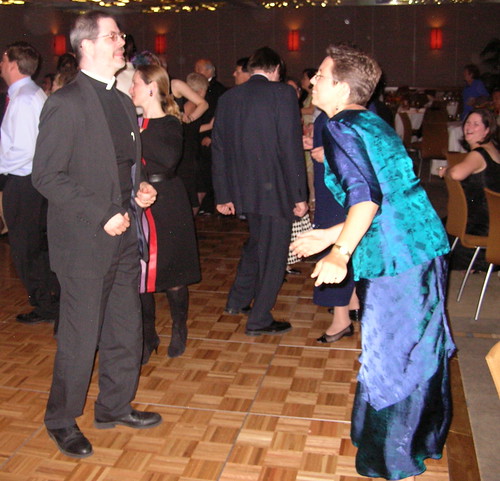
I’m going to a dance party tonight, and my fondness for the host doesn’t for a moment alleviate the deep dread I have of dancing in front of people who know me. I danced for a brief interval after Si and Laura’s wedding, and before that at Joey and Wendy’s
 

Old Timers Rock'n'Roll


— but my sense of 100% awkwardness comes to the fore when dancing. I will go ahead, and I’ll dance, but it’s under the heading of “afflicting my vanity.” If I survive the mortification, I will let you know tomorrow.
 

Yes, I Am That Small

IHE reports that Rice University closed up its all-digital university press. That’s sadly noteworthy for its own sake; it exemplifies the institutional short-sightedness that’s been afflicting the academic-research-publishing-teaching nexus for years. What really caught my eye (“bought my eye,” if you remember the Monty Python “Travel Agent” sketch) was the assessment by outside evaluators, from which I will quote in extenso:

[T]he outside reviewers who recently finished a study of the press recommended in their report — a copy of which was obtained by Inside Higher Ed — that the press move further away from a book-oriented model and become a teaching and research center that explored new forms of scholarly communication. Such a broadening of the press role, the committee said, would attract outside financial support and enhance the university’s programs.
 
Turning the press into a scholarship laboratory, the report said, “challenges and transforms the traditional notion of the university press, which now becomes not a ‘press’ in any ordinary sense of the word, but rather a node for experimentation, research, and dissemination, linking together the teaching and research core of Rice University, the Rice University Libraries (in the form of the Center for Digital Scholarship), the university’s main research centers (HRC, etc.), within the framework of an outreach structure (RUP with Connexions serving as only one of a number of supports).
 
“Like a conventional university press, RUP would, through the work of its publisher, continue to seek out and recruit internal and external projects that live up to its mission of modeling the future of scholarship. A traditional peer review process would be applied to the evaluation of these projects, however unconventional their form (a multimedia publication, geo-spatially organized repository, a print/digital hybrid ‘augmented’ book). But RUP would also serve as the completion and publication site for the most innovative locally produced (via Rice’s research centers and institutes) projects, subject to precisely the same peer review controls.”

I wasn’t one of the evaluators, but I couldn’t have said it better myself. Indeed, I may incorporate this passage in my next grant proposal; it’s almost exactly what I’ve been saying for longer than ten years now. (Except that I’m not anti-book — I think there’s a long future for books that the exciting prospects of other and mixed-media communication tends to obscure). Yes, I am that small: I told you so. The burning question remains, Who will pick up this mission and put it into action?
 

Nonfiction

Tuesday, alas, Frank Kermode died. A great many biblical scholars recognise his name for The Genesis of Secrecy, his Norton Lectures at Harvard University; some of them know his critical classic, The Sense of an Ending, or his writing and editing for the Literary Guide to the Bible. I admire his books (Secrecy more, I think, than Ending, and I’m lukewarm about the Literary Guide), but few things I have read delighted, instructed, wooed, and impressed me more than his collection of essays published in the US as The Art of Telling, and over here also by the truth-in-packaging title of Essays on Fiction 1971-1982.
 
In these essays, he walks his readers through the rationale for his approach to criticism (summed up in the Prologue as “finding out what texts seem to be saying as it were voluntarily, and. . . conveying this information to others”), and displaying that approach and its implications. When I return to “Can We Say Absolutely Anything We Like?” or “Institutional Control of Interpretation,” I see a beam of critical light that helped me orient my own sense of what’s what while I was navigating the wilds of postmodern theory (on one hand) and the doldrums of conventional biblical hermeneutics (on the other). Not unsophisticated when it came to theory — and vigorous in support even of theoreticians with whom he disagreed — he was above all an incomparably gentle and subtle reader.
 
I am tempted to quote him at length on any number of topics; he writes lucidly, radiantly, critically, and beautifully about the texts on which he comments. I don’t by any means always agree with him, but I always wish I had his insight, his erudition, his patience, and his capacity to make himself and his topics clearly understood. By all means enjoy The Genesis of Secrecy — I will always cherish my autographed copy, signed when Kermode came to give a lecture at Yale in 1984 or ’85 — but soak up The Art of Telling, too. (If nothing else, you may understand my hermeneutics better, not that that suffices as a motivation).
 

Going Around

I’m walking on air, since I know I’ll see my beloved in just over two weeks, but am thrilled to share the joy with Steve Himmer. Steve and I go way back to the boondocks days of Blogaria, we’ve couch-surfed back and forth, we’ve rejoiced and grieved together [digitally]. And now, we get to raise a glass in celebratory honour of his having found a publisher for his ground-breaking first novel, The Bee-Loud Glade!
 
There is no better friend among living novelists, and I am sure as can be that this marks the beginning of an exciting shelf of published works. I’ll be hoping we have the opportunity to arrange for Steve to return to old haunts and give a reading at the University of Glasgow.
 

Puzzling Reasoning

Mark C. Taylor has quite a reputation in the arena of postmodern theology. I’ve never been especially enthusiastic about his writings; they struck me as uninteresting, but I have been willing to take my colleagues’ word that he’s brilliant (and his position as chair of the Religion Department at Columbia suggests that his colleagues share that assessment).
 
A while back, he began making splashy media appearances concerning education and technology. He garnered some very generous support for ideas that seem to have fallen by the wayside, but (in the way such matters go) that seems not to have affected his reputation as a pundit, and now he’s pontificating about the future of the university as part of the publicity campaign for a forthcoming book. He’s against academic tenure, against institutional expansion, and is not obviously self-critical about his own position as a celebrity and Ivy League department chair.
 
I have some questions about academic tenure myself. Let me hasten to say I’m a union man from the word “go,” and tenure marks such a remarkable achievement by academic labourers that I don’t blame anyone for clinging to it. I’m not persuaded, though, that it benefits all academic labourers equally well, nor that the unequal benefits actually make so great a positive difference for the profession that it’s worth perpetuating tenure. But hey, I’m willing to listen, and am certainly not argumentative about the topic.
 
But even my predisposition to contemplate alternatives to the present system (and my goggle-eyed amazement that universities think it makes any sense to expand facilities rather than investing in the teaching and learning that constitute the raison d’être of higher education in the first place) doesn’t suffice to make Taylor’s ill-considered vagaries the least bit enticing. Even when I’m inclined to sympathise with arguments that he makes, he makes them so haughtily and imprecisely that I have a difficult time reconciling his academic reputation with the out-of-touch rhetoric of his pedagogical proposals. Candidly, he writes so carelessly about education that I’m inclined to suppose that my assessment of his theology has less to do with simple divergent paths, and perhaps at least a shade more to do with slipshod reasoning.
 
It’s getting toward time for me to dress for my day’s business, but Taylor’s confession that he “honestly [doesn’t] know what a lot of academics do a lot of the time” ought to rule out anyone’s taking him seriously. On what basis does he write about revolutionising the higher-ed industry when he himself admits that he doesn’t know what the labourers do?
 

Where It Went

For some reason, it seemed to me to be a good idea to get up early yesterday morning. I know, I know, I can hear you ask “What were you thinking?” I was thinking — soundly, to a point — that I would go to a car boot sale (a flea market, in US English) and since I wanted to scout for under-priced fountain pens, and when you’re looking for under-priced specialty items you should get there early. Right? Right.
 
Alas, Polmadie has gone the way of US flea markets, and now — rather than comprising all garage-emptying or estate-settling sales of household goods, it’s dominated by people with packaged goods that somehow came into their possession: batteries, hand tools, light bulbs, some health and beauty aids. There were some miscellaneous household items, but it was not the setting for pen-hunting that I had hoped. That’s OK; it was good exploring and learning, and I had a good time.
 
On my way home, I stopped at some charity shops and at the one antique shop in Partick. No one had fountain pens, but the proprietor of the antique shop tipped me off that an antiques and collectibles show comes to the West End once a month, and that it would be in Glasgow today.
 
That mean that I would get up early today (not because I wanted to get to the antiques fair early, but because I had the 8:30 mass at the cathedral). I was needed for the 10:30 service also, so I had my coffee and croissant at the Bay Tree, where I spent a happy hour thinking hard and having delicious ideas. After the second service, I hurried to Kelvin Hall to catch the antiques show, where I spent a few minutes admiring the display of Peter Crook’s pens, and the antiques on offer from many other vendors — altogether a more satisfactory experience.
 
But time was marching on, and I had gratefully accepted an invitation to Sunday dinner at Vicky and Margaret’s, so I hustled home, changed out of clericals, trundled down to Partick Station, took the train to Anniesland, enjoyed a marvellous dinner of stuffed pepper and roasted vegetables, followed by much conviviality. So now that I’m home, I’m footsore, weary, full, sun-warmed, and ready to turn my brain off, watch a diverting movie, and go to bed early — since I have Morning Prayer and a clergy staff meeting, and then lunch with a colleague, already committed for tomorrow.
 

Tick Another Box

As a footnote to yesterday’s post about Margaret’s visa application being in the mail, the other legal matter we needed to take care of before she emigrated was transferring the title of our [former] car to our friends who bought it from us. This was a great nuisance, because Pippa and I bought the car in Durham while Margaret was on a longish stretch in Baltimore — so my name is on the title, so she couldn’t sign the title over by herself. It’s all done, though; we have one fewer asset in this world, and one fewer task to accomplish before Margaret’s departing. Maybe it’ll really happen!

Alienation

In the 1970’s, the University of Glasgow elected as its rector the Communist Party member and Labour candidate for Parliament Jimmy Reid. At the time, he had triumphantly spearheaded the unions’ efforts to keep the shipyards alive by refusing not to work.
 
Jimmy Reid died on Tuesday, and in this morning’s Independent ran the text of his Rectorial Address, which (according to the Guardian) the New York Times compared positively to Lincoln’s Gettysburg Address. look it over in the Independent, or download a PDF of the University’s original printing of the speech. I am saddened that such a voice be silenced at a time we need it so badly as an audible conscience to the University and to the economy.


Now I’m pondering the fact that the only two Rectorial Addresses I can recollect are Jimmy Reid’s and Martin Heidegger’s.