No Pain, No Wordcount

The weekend has passed with a certain amount of writing stress, but I think I’ve pretty much settled the hash of my paper entitled “René Magritte, Krazy Kat, and Truth in Interpretation,” which I’ll test-drive on Tuesday for some Princeton Seminary students with an interest in Emergent Church, and will offer in final form to the Society of Anlgican and Lutheran Theologians on Thursday. I’ll post a synopsis of it here tomorrow, deo volente, with a link to a PDF of the full text.

When Did That Happen?

Last night, Margaret and I went into New York to visit with Joi and a couple dozen of his other friends; we had a fantastic time, and Joi caught a lovely contemplative photo of Margaret (in extremely low light), plus a shot in which she’s giving him a quizzical smile, and a better-than-real-life picture of me (which he’s already added to the Wikipedia page about me), plus one in which I look a little glazed (the spotlight over my head adds an interesting element to that one).

But the topic I wanted to discuss was The Roots, of whose act we caught a few minutes. I had listened to Game Theory when Nate urged me to check it out, and I noted it as a noteworthy example of strong hiphop. But mercy sakes, last night they rocked, hard and tight. They played “Don’t Feel Right” and another song I didn’t recognize, and in between an amazing cover of Bob Dylan’s “Masters of War.” I’m revisiting Game Theory now, but if someone knows of cuts where their capacity to display the terrific ensemble playing and hard rocking they showed live, I’d be all over it.

[Later: Last night, Jackson Browne opened his mini-set by playing “World In Motion” (brave man, to cover Pops Staples!) — and today, Pops’s original version showed up in my shuffled playlist of roughly 13,000 songs for the first time in months. I’m just saying. . . .

Still later: And the joke’s on me, because it’s Pops Staples who covered Jackson Browne’s original!]
Continue reading “When Did That Happen?”

Adiumache

I’m just not going to upgrade Adium again for a long time. After the last time, I threw out my whole Keychain and started fresh, which solved the slowdown I experienced when I last upgraded (though it meant re-entering all my passwords). Yesterday the “upgrade” option popped up again, and like a good doobee I hit the “upgrade and install” button.

Blammo! The same again — massive slowdowns across the board while Adium and the Keychain work out their interaction. Oddly, they don’t overload the processor; the system load drops to almost nothing while Adium negotiates its access to the Keychain, but all processes go at a snail’s pace. Once Adium gets happy, everything returns to normal. But this is much too big an annoyance to put up with more than once in a great while, and if I didn’t have a bunch of friends using incompatible messaging protocols, I’d just go back to iChat.
Continue reading “Adiumache”

Linkcheck

It’s a little bit of a shame that the phrase “link check” or the compound “linkcheck” has been appropriated by the (very sensible) endeavor of making sure that one’s hyperlinks are well-formed and current. I appreciate valid linking as much as the next person, but I was hoping I could coin the term to apply to what Jordon calls “contextless links,” or for the inclination to make explicit reference to other online writers when the occasion presents itself (by analogy to “namecheck”).

Anyway, I wanted to linkcheck Scott McLemee’s review (which points to the New York Magazine review) of Pierre Bayard’s How to Talk About Books You Haven’t Read. The reviews and the book itself sound partly right, partly elliptically determined by an unspeakable aversion to saying directly what they’re trying to get at.

And this morning’s Dilbert cartoon captures the thought that more than once has flashed through my mind when I heard someone enthuse about “innovation.”
Continue reading “Linkcheck”

Is That Good or Bad?

Somehow I suspect that there’s an implicit judgment of obscurity and pretension lurking in the assessment, but the “Blog Reading Level” site suggests that I make it pretty demanding on visitors here:

Tough Sledding

If you go to their site to try your own blog out and then paste in their medallion, you may want to edit the HTML they supply to omit the link that seems to point to an online loan shark.

Meaning as Expression-Apprehension

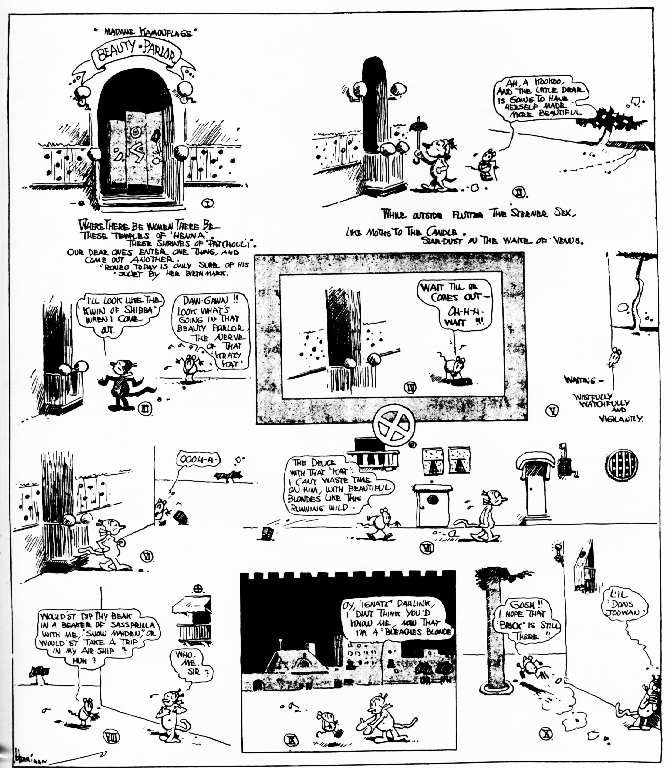
In a comment over at Gift Hub I suggested that the activity of “meaning” is less like “putting a birthday present for Margaret into a box” and more like “gambling that an audience will receive an expression in the way that one hopes.” There’s been some illuminating discussion there (and Phil added a subsequent post also). As I scour the world for Krazy Kat support (trying to track down a finer copy of this image from July 14, 1918), I’m turning this interpretive model over and over, trying to figure out whether I want to venture it as a reference point for my upcoming paper.

Notion

I’m aware that some scholars have suggested that the stories about Jesus were arranged to fit parallels in Scripture (the Old Testament) for the synagogal lectionary cycle; that always seemed too much of a stretch to me. But this morning it occurred to me that the pattern of Jesus’ career might — whether out of a literary theology, or a divine salvation-historical typology — be set out to correspond to the festal year. Certainly the gospels make a great deal of Jesus’ death at the Passover; Luke emphasizes the gift of the Spirit at Pentecost. The eschatological tribulations and renewal of the world cohere with atonement and new year. The cultic language of “first-fruits” resonates with the sacral year.

The gospels don’t seem to associate Jesus’ birth with any distinct holy day (the dating of Christmas near Hannukah is later). Are there additional data that might harmonize other moments in the messianic plot line with holy days from Scripture?

The Big Question

In an interview David Simon, with the writer behind The Wire (which I’ve never seen, but may have to catch up on via DVD, along with Buffy), the interviewer asks, “How do you distinguish between the good and the mediocre?” As Pippa and her god-sisters Monica and Emily used to say, “Bing bing bing bing bing!”

Simon answers the question relative to a newspaper’s journalistic mission (the topic about which he and the interviewer were talking).

You see these sort of ‘we gotcha’ stories, bite sized morsels of outrage, half-assed scandals. No one is tackling big problems. That kind of ambition is gone. When I went into journalism school, which is over 20 years ago now, high end journalism seemed like it was growing by leaps and bounds in its ability to assess the most delicate and ornate contradictions in society. . . .
What happened to the people who are supposed to be sounding the alarm? While the unions die, while the jobs disappear, while the political infrastructure dispatches one reformer after another, while the police department and the school system and every other agency create systems to deny the obvious – that they’re not doing their jobs anymore – while all this is happening, what was the external monitor doing and paying attention to?

It’s good to see Simon calling attention to the corrosive effects of profitable cultural mediocrity; now I’ll spend a few minutes thinking over how this plays out in church and academy. [Link from the estimable Doc Searls.]

Paging Dr. Bechtel!

I heard a rumor that Trevor successfully defended his dissertation at Loyola last week. While we await the official conferral of the degree, we toast a distinguished scholar and wonderful friend — three cheers, Trevor!

Initials, Pro and Con

Dorothea lets off some steam directed at disciplines, journals, conferences, and authors who present their names by initials followed by last name. She has some advice for them all: “DON’T.”

I’m piqued to note this today, because my credential badge for the annual SBL meeting arrived the other day, and it read “Andrew Adam.” Now, when I filled in the forms for registration, I typed “A. K. M. Adam,” and when the forms reviewed all the data in order to confirm it, the forms all showed “A. K. M. Adam.” The confirmation email said my badge information would read “A. K. M. Adam.” (I’d upload a screenshot of it, if anyone cared.) This is important because every book I’ve written, every article I’ve written, every book review I’ve published, my whole professional life has borne the label “A. K. M. Adam.” There are few enough people who read and note my stuff, that when one of them meets me, I want them to know I’m that guy.

Nothing against the name “Andrew” —I like it very much. It doesn’t, however, communicate that “the bearer of this nametag is the person whose books you may have read, who’s appearing in several conference sessions, whom you know to work at Seabury-Western.” And with due respect to Dorothea (and “due” = “a whole lot”), I don’t want disciplines, journals, conferences, or registration bots to start unilaterally altering my self-presentation — whether contracting “Ermintrude Regisphilbin Wattbottom” to “E. R.,” or assigning me an unrequested “Andrew.” Initials: maybe, maybe not; consistency and consideration, absolutely.

Ugh

I’m leaving long comments in various other places online, and I need to nail down the “Krazy Kat” part of my presentation today (and it’s not cooperating; I think I may have erred in promising to include Herriman in my talk, I think this particular train of thought doesn’t stop at the Coconino County station, and I’ll be throwing the flow off by incorporating him), so i’ll just note that a Verizon-functional gPhone sounds sweet to me, and then will hunker down and try to squeeze out another thousand words.

10 – 20 – 30

Tim thinks that by tagging me to identify where I was ten, twenty, and thirty years ago, he’ll gain some interesting context to support the reminiscences he’s seen here; I fear that my answers will strike someone with as varied and exotic a life as Tim’s as distinctly dull. Let’s see:

10 years ago, I was teaching here at Princeton Theological Seminary. Back then, my hair was much monger — well down my back, in a pony tail — but really, that’s about it. Margaret hadn’t begun her graduate studies; Nate, Si and Pip were all still at home; Jennifer and Juliet were probably both living with us (Jennifer’s coming to visit later this week); I was looking for a job, since my position at Princeton was non-tenurable. We loved Princeton back then, the town and the seminary students and my colleagues.

20 years ago, I was making the transition from my masters studies at Yale Divinity to my doctoral work at Duke. We had to leave Margartet’s beloved dog Pearl behind us (no dogs allowed in the only apartment we could track down); Nate was two, and Si was not yet a year old. I had served as day school chaplain at St. Thomas’s Day School (preaching every morning to a group that includes junior kindergardeners through sixth grade and their teachers puts a lot of mileage on, fast) and as Assisting Priest at Christ Church, New Haven; at Duke, I helped Earl Brill with the campus ministry, but mostly concentrated on my studies (I had a three-year grant, and needed to be employed full-time when it expired, so feed the family).

30 years ago, I was a college junior at Bowdoin. Now there are some stories to tell about my junior year! For the purposes of summary and discretion, let us simply indicate that I had experienced some heartbreak, some other sorts of stressful turbulence, I had started carrying around a coffee cup with me everywhere and filling it when empty, and — this will surprise you — more or less stopped eating and sleeping. I realized that I needed to cut out the caffeine, and after a couple of weeks could resume a more healthy regimen. I also had the disturbing realization, through a medical ethics class, that although I could win an argument on either side of a contested point, I didn’t really have any coherent principles to shape my sense of which position was right.

The next year, I met Margaret.

From Ago

I did not sample a madeleine in tea yesterday, but I revisited a longtime friend whom Blogaria knows as Will Smama. We met in the fall of 1990, when she took one of the first classes I taught at Eckerd College. I was underprepared for beginning my life of teaching, as I’d been furiously typing away at my dissertation, but WS put up with me anyway; she majored in Religion, and took several more courses from me. She was a friend to Nate and Si when they were cute and little (this warrants, I think, a link to the classic Halloween picture that attracts a lot of search engine traffic this time of year — Si on the left, Nate on the right, and their friends in the middle).

Halloween 1993 - ish

OK, enough of that. After WS graduated from Eckerd and I went to teach at Princeton Theological Seminary, she was called to ministry in the Presbyterian Church, so she came to study again where I was teaching. Now that I’m back in Princeton for sabbatical, and she’s on vacation from her congregation, we met up at the sand pit in Marquand Park.

Although I enjoyed the chance to catch up, to talk through the various transitions and turbulences and lessons and delights in our lives, the very best part of the visit was the chance to meet Will. He truly is, as they say, all that.

Will's Mama Is Number One

Will in Sand

Thanks so much for stopping by, WS, and for introducing me to Will. Thanks for long-lasting friendship and a loveliness in life that you’ve given now to Will, that you’ve shared with a blessed congregation, and that touches your many, many friends.

Will With Smama

Clarification and Emphasis

I’m reading a book just now that makes the repeated claim that the New Testament itself, the plain sense of the text, requires assent from its readers — and that provokes me to refine the point I was making yesterday. I don’t want to assert that any reader who picks up the New Testament and reads it “competently” confronts the challenge to accept it or reject it, with ultimate salvific implications. Rather, I would argue that for someone (like me) who recognizes the gospels to speak divine truth, a reader who appreciates the Bible but does not participate in the life to which we understand them to point has forgone the opportunity to share the fullest resonances, insights, possibilities, and truth. I expect that an uncommitted historian of the ancient Mediterranean could say that someone such as I who has already given his profoundest allegiance to the New Testament misses out on the fullest understanding of Mithraic, Gnostic, even non-religious Hellenistic texts, and they would be right.

The point isn’t to construct a binary opposition between True Believers and Woebegone Doubters, or to set up the biblical text as self-determined Salvationometer. The point is that sympathy inescapably inflects understanding, and someone who withholds full sympathy (for whatever reasons, I’m not judging the reasons in question) holds back from the opportunity of fuller apprehension.

Told Them So

Cardinal Urges Religious to Get Blogging” (thanks to Jeneane for the heads-up). In my “technology and religion” article, I addressed enither the ignorance that leads Cardinal Ruini to say, “I don’t understand the Internet, but especially young religious ought to enter blogs and correct the opinions of the youth” nor the “cult of professionals” rhetoric that Andrew Keen and (now, thx David) Donnacha Delong spout. I’m not inclined to revise the article so extensively as to engage those angles, but I’m kicking myself (gently) for leaving them out.
Continue reading “Told Them So”

Commitment, Ambiguity, and Reading Scripture

I’m working on my paper for the annual Society of Anglican and Lutheran Theologians meeting, and for inspiration combing my back catalogue of quotations — my Commonplace Book. There I found the following quotation:

Liberals believe that facts (of history, justice, science) are independent of the knower, and that it is the knower’s obligation to approach the task of knowing with as few preconceptions as possible so that the understanding he finally achieves is impersonal rather than a reflection of his antecedently held views and preferences; one must come to any situation calling for a decision (about what to think or what to say or what to do) with an open mind, a mind prepared to jettison its most cherished convictions should the evidence tell against them. Liberals believe that evidence lies about in the world waiting to be gathered and then arranged in patterns it itself suggests. Liberals believe that if we are sufficiently careful in our gathering of evidence (careful, that is, to keep ourselves and our desires out of the process) the truth will finally emerge in a form everyone (whose mind is open) will acknowledge. Liberals believe that when the truth is to be determined, the meaning (political, moral, legal) of an action, the previous history of the actor—whether he has in the past been a good or bad man—is largely irrelevant and that we should look only to the shape of the present circumstances when assessing him. And because liberals believe in all of the above, they believe in the efficacy of procedures—scientific, parliamentary, judicial—designed to protect us from the overhasty judgments we make when we allow our commitments and allegiances to blind us. Liberals believe that the most important of these procedures is the machinery of rationality, of those laws of logic attached to no agenda or vision, but sufficiently general in their scope as to provide a normative perspective from the vantage point of which any agenda or vision can be assessed and, if necessary, corrected. Liberals believe that communication and persuasion take place (or should take place) in the context of that rationality and that it is possible to bring anyone—except, perhaps, the mentally impaired—to a clear understanding, so long as he or she is willing to set aside or bracket all biases and preconceptions.*

Juxtapose this account of liberal reason with the overwhelming mandate from conservatives and liberals alike that biblical interpretations be resolved by appeal to a discernible meaning inherent in The Text, that any rational, well-informed reader can excavate. To the contrary, some truth offers itself only to the scientist whose heart is already attuned to it; in order to recognize the truth in poetry, one needs some prior initiation to the world of indirection, figure, allusion, rhythm, harmony. Some truth offers itself only to a seeker who has learned to cherish the regularities of number, the elegance of economical proof, the unwavering dogmas imposed by probability, the transcultural good news that a common language with common axioms can crack open sealed crypts of creation and yield cures, forecasts, remedies, and explanations. But the truth avails always to interested parties.

This, I think, touches on the conflict over Scripture and bunk: not that an uncommitted reader can’t ever arrive at a true interpretation of Scripture, so much as that a committed reader stands to apprehend vastly more richly the common language, the rhymes, the dogmas, the figures that will not have registered on the awareness of the uncommitted reader. And that in an ultimate mode of reading, interpretations that do not conclude in committed practice partake of rejection of the truth. To hark back to Milton’s anti-liberalism, the condition of setting aside and bracketing all preconceptions itself entails a spiritual impediment to recognizing the truth.

As a reader of the comments from which this conversation emerged will note, I resist the dichotomy between “intelligible” and “unintelligible” that fuels much of the controversy. First, my observation of interpretation suggests that “intelligibility” always involves degrees of intelligibility, never complete transparency or utter opacity. Second, I doubt that even a judge much more humble and saintly than I, can or should issue ukases about who can and can not perceive the truth; as Milton would have pointed out, anyone who bears the effects of sin (that is, “all of us”) must say with the Apostle, “I have no word from the Lord on this,” must reckon her- or himself to be one of the field-working servants rather than the harvesting angels who can separate wheat from tares. “Such a man as this rejoices in everything; he does not make himself a judge of the servants of God, nor of any rational creature; nay, he rejoices in every condition and every type that he sees, saying, ‘Thanks be to Thee, eternal Father, that Thou hast many mansions in Thy House.’ And he rejoices more in the different kinds of men that he sees than he would do in seeing them all walk in the same way, for so he sees the greatness of God’s goodness more manifest. He joys in everything, and gets from it the fragrance of roses. And even as to a thing which he may expressly see to be sin, he does not pose as a judge, but regards it rather with holy true compassion, saying, ‘To-day it is thy turn, and to-morrow mine, unless it be for divine grace which preserves me’ ” (Catherine of Siena). Such a reader may decline the invitation to share at the table that nourishes faith, but it would be an odd thing if the spiritual joy-in-diversity that Catherine celebrates didn’t normally involve participating in the faith it celebrates — odd, if that eucharistic nourishing weren’t generally concomitant with interpretive flourishing.


* It’s from Edward Oakes’s review of How Milton Works by Stanley Fish, quoting Fish himself in this paragraph.

Ngognog Ngogn

We are not at church. We volunteered to dogsit for some Princeton friends of ours, before we fully apprehended the consequences of that offer — namely, that the pug for whom we were caring is accustomed to sleeping with his owners, indeed, to burrowing into the bedclothes adjacent to them. And snoring. Add to that Beatrice’s pangs of dispriz’d love, such that she could not control her whines and moans nor keep herself from snapping and growling at the indigenous pug. And an aging Westie, who keeps her own counsel and nips at anyone who presumes to propose an alternative (based on human sensibilities). All of this made for two sleep- and comfort-deprived adults, one of whom is now lying abed while the other attends to Bea’s needs, in anticipation of swapping off in a while.

Judeans In the New Testament

I’ve been gratified to observe a small flurry of activity on the web recently, supporting a proposal I first made a long time ago: that we stand better to understand the New Testament and the history and politics surrounding it if we read the Greek word Ioudaios as “Judean” rather than “Jew.” A while ago, Bruce Malina, John Pilch, and Philip Esler (in separate publications) advanced this position on social-scientific grounds. Frederick Danker indicated that “Judean” best defined Ioudaios in his revision of the Bauer Lexicon. Back when I put it forward (first in a seminar paper at YDS in 1986, then in print in Journal for the Study of the Pseudepigrapha 14 (1996) 15-21 and in the Greek textbook I wrote), I made the case on a more general semantic/historical/cultural basis. Since then, in reading the New Testament, my tentative hypothesis has been confirmed over and over again — the narratives just make more sense if you shift the focus of attention from the Jews to the Judeans.

At this point, it’s vital that I stress that I’m not saying “There were no Jews in the New Testament” as though there were only Aryans, or no one practiced the faith and laws handed down from the judges and prophets through the priests and rabbis. Indeed, part of the strength of the Judeans proposal lies in the fact that it appropriately subsumes Jesus and his bunch under the same cultural umbrella as their Pharisaic and Essene and Sadducee neighbors. They were all adherents of the Torah and Temple; some were Judeans strictu sensu, some were Galileans, some were Nabateans or Idumaeans, and outsiders such as Romans didn’t bother to make nice distinctions among them. The goal isn’t to produce a Judenrein Gospel, but to make clear that Jesus and his buddies weren’t an exception in the theological-cultural milieu of citizens with whom they lived, worked, and argued.

About a year ago, Loren Rosson revived the question in his blog to which Carl Conrad assented on the B-Greek mailing list). Since then, John Elliott has published a pertinent article in the Journal for the Study of the Historical Jesus, which Rosson summarizes in a separate post — and A.-J. Levine has published a fervent riposte to advocates of first-century Judeans. A flurry of blogged responses to Rosson ensued. And now, Phil Harland points to an article by Steve Mason in Journal for the Study of Judaism.

As the testimonies stack up, we should pause before concluding to note (a) that none of the “Judean” proposals involves deprecating anything about the religion, ethnic identity, practices, literature, integrity, or any other aspect of the cultural life of Judaism — indeed, many proponents of “Judean” demonstrate a consistent interest in promoting appreciation of the lives, beliefs, and practices with which we’re concerned; (b) the arguments they’ve advanced all rest on pretty uncontroversial premises, save Esler’s argument that we are obligated to show our respect for ancient forebears by characterizing them in accordance with their self-identification (and even that is not an outlandish claim, albeit controverted); (c) antiquity did not draw the strong distinction between state, ethnicity, and religion that 20th-century liberal democracies do, so that an ancient observer will justifiably assume that a “Judean” worships the god of the Judeans, owes loyalty to a Judean head of state, and is descended from (or adopted into) the Judean ethnic group; (d) a great many texts of the New Testament, as well as other ancient sources concerned with the people of Israel, make more sense if the retrospective term “Jew” is not used; (e) one particular benefit of that usage entails clarifying the conflict in John’s Gospel as a dispute among regional factions (Judeans vs. Galileans) rather than rivalry between “Jews” and “Christians.”

I do not suppose (as Harland does) that Mason’s article closes the question. I do hope that this groundswell of exegetical energy banishes glib dismissals (one eminent Neutestamentler is reputed to have said, “That’s just political correctness”) and forces the issue out into the open terrain where we can muster contending arguments. The longer I live with the conclusion that Ioudaios should be understood as “Judean,” the sounder it seems to me.