If The Lagoon Was Whisky

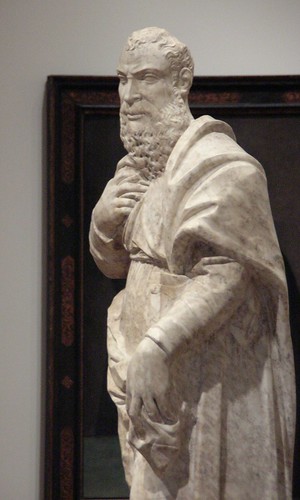
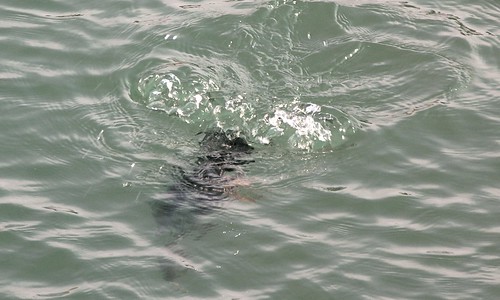
Pippa and I have been watching with fascinated delight the antics of a solitary diving duck among the innumerable dabbling mallards on Northwestern University’s campus lagoon. We haven’t agreed, however, on the precise identification of our unknown subject.

Diving Duck

The European Red-Crested Pochard bears a certain resemblance to our suspect, but since ours lacks the red bill, and since Evanston is not in Europe, we’re disposed to rule that one out. It could be a Redhead, though ours lacks the distinct black chest-grey torso coloration.Its golden eye might make you think it was a Goldeneye, but Goldeneyes seem to bear the characteristic white patch on their upper neck — but the immature Goldeneye, or perhaps a female, could resemble the perpetrator we’ve apprehended.

Diving Duck

Feedback from keener-eyed, more expert birders would be welcome.

Duck Diving

Continue reading “If The Lagoon Was Whisky”

Mail Clog

My Apple Mail application no longer searches its database for strings I type into the search window. Like a digital Wally, it simply disregard the search strings I enter, or returns a desultory two or three recent messages. I don’t have time, at the moment, to search Apple’s site for answers, but if you’re waiting for email from me — this probably isn’t why I haven’t answered, but it’s a good enough excuse for today.

[Later: Kevin pointed to this nifty command-line trick for speeding Mail up; I had seen it and forgotten about it when the report flashed into view ten days ago. Unfortunately for me, my problem is not that the search is too slow, but that it refuses to search thoroughly altogether. If I search all mailboxes for a relatively simple string — say, “the” — it will find many of the most recent messages, but only sporadic instances of the search term as the pool gets older and older. If I’m looking for a term that appears only in old messages, it’s likely not to show up at all.]

42

I was going to blog about David Weinberger’s newsletter reflections on “meaning,” but today;s beginning to look a little crowded, and elsewhere I wrote a long response to someone who was asking about The Law of Attraction and The Secret. I’m reposting it here (slightly edited) in public, with the proviso that this response is directed toward a group of people some of whom expressed vigorous admiration and some vehement rejection of the phenomenon — and I’m trying to stake out a position that’s pastorally gentle while remaining critical of the bogus side. My less restrained friends Chris and the Tutor would probably couch their assessment with more scathing prose, and I yield to them on composing such.


At the outset, I’ll stipulate that one’s attitude makes a big difference in one’s life — and not exclusively “positive attitude = better.” In the aggregate, people tend to respond more warmly to people with positive attitudes; that amplifies certain possibilities and certain opportunities an increment, and of course if you have a positive attitude, that increment is going to seem bigger. There’s a circularity to that, but it’s not simply chasing your tail.

Depressed people, though, are likely to see the world as it is more honestly. Suffering and unfairness that positive attitude-holders may shut out from their awareness, unwilling to weigh down their consciousness with misfortune, stand out and claim the attention of someone affected by depression. It’s not the world’s cheeriest upside, but it’s true, and I know people who would rather stick with their depression and see misery in sharp focus, than to accept therapeutic intervention that would make them “cheerier” at the cost of what they take to be their vivid realism.

With regard to the specific premises advanced in this movie and book: I have not read the book, nor did I watch more than the first few minutes of the Google video. There may be mind-blowing pearls of hidden wisdom that I did not encounter in my inadequate sample size.

That being said, it looks to me as though the author and filmmaker are trading on an ambiguity in the word “secret.” If I say, “The secret to getting to Carnegie Hall is practice,” everyone knows (a) that it’s not a secret (b) that the force of the word “secret” is more like “fulcrum” or “method” or “answer.” In one sense, then, I take it that the claims I hear in this short film segment are uncontroversial, if hyperbolically overstated: a positive attitude is likely to impress others positively and amplify their esteem for you, etc. How much of a difference this makes, who knows? It’s not a revolutionary difference in the aggregate, but particular people may find extreme success this way, and their endorsement tends to drown out many other people’s disillusionment. That doesn’t mean it wasn’t helpful for person A; it just means that we shouldn’t be surprised if person L is more like people B, C, D, E, F, G, H, I, J, and K for whom this approach didn’t work.

The other aspect of “The Secret” is more problematic. For ages and ages and ages — perhaps it’s innate, I decline to speculate about that — people have wanted to know the secret. The popularity of ⟨/gag⟩ The da Vinci Code and the persistence of esoteric traditions provides sufficient testimony that many people are predisposed to think that there’s some sort of Hidden Answer that is open to The Right People, but that mere ordinary humans don’t have access to. The opening sequence of the movie trades on this use of the word “secret,” but think for a moment: if Plato, Shakespeare, Newton, and Emerson are the sources for this “secret,” just how “hidden” can it be? People have been reading Plato for, what, 2300 years? Do you have to go to your neighborhood metaphysical bookstore to get a copy of Macbeth? And among the few people who actually read Newton instead of learning his formulae, do we have reason to suppose that they discover a concealed message about prosperity and well-being? As for Ralph Waldo Emerson — to whom I’m distantly related — he blends a reasonable emphasis on human capacities and self-discovery (which I dissent from, but recognize as intellectually reputable) with a self-congratulatory neo-Gnosticism to which I strongly object.

But, it makes some people feel good to think that they’re in on the Sooper Sekrit (best-selling, unsubstantiated by experimental verification) answer to the universe — far more than actually benefit from the sound application of positive thinking (itself a limited, not universal, good thing). On the whole, this is not my cup of tea, even though I tend markedly to “think positively” more than most people. For me, that means mostly just thinking the best of people, so as to give them room to be better than they might be if I approach them with suspicion; trying to emphasize my own strengths and my capacities to deal with stress, frustration, and misfortune, rather than wallowing in the self-pity and complaining to which I might otherwise be inclined (and I’m far from perfect on that score); and concentrating my energies and attention where there’s greatest likelihood of some positive response.

Oooops, I guess it’s not secret any more. Well, if I disappear from the face of the earth, you’ll know that the vast international conspiracy to suppress the truth has gotten to me. Of course, then they’ll probably delete this post, too, just as they so successfully suppressed The da Vinci Code and the Law of Attraction book and movie. If “lack of public attention” is one’s criterion for “secret wisdom,” then my books are exponentially more reliable than either TdVC or Law of Attraction.
Continue reading “42”


Closure

Yesterday was the last day of Epiphany Term classes (I’m sticking with the archaic ecclesiastical terminology, since next year we’ll probably just call them “Fall Semester” and “Spring Semester” like every other educational institution). This week I finished a book review, an article, and a sermon; I have one book review to go, and I’ll be caught up to my usual degree of behindness. I have two stacks of papers to grade.

But Pippa has decided it’s time to begin spring cleaning, and she’s right. We spent a couple of hours this morning in the “study” clearing out bags worth of debris. We aim to clear out that room, and then move on to our next victim. The whole place has to be whipped into shape before we leave for Princeton in the summer. In the meantime,though, if you want to see some embarrassing childhood pictures of Nate, Si, and Pippa — or embarrassing early-adulthood pictures of Margaret and me — I know right where to find them.

Positive Outcomes of Vanity

I’ve been checking over at the Christian Century website more regularly these days, as they asked me for a column responding to the recent meeting of Primates and the Communiqué that the meeting promulgated. Those visits stem partly from vanity, but also partly from a degree of worry about how the column will be received (on which more later).

Because I was paying attention, though, I caught two columns that impressed me very favorably. James Alison’s piece on drowning in theology aptly communicates the joy of coming to understand what you thought you already knew — and that understanding disclosing vast frontiers of yet-undiscovered brilliance and depth and wisdom.

Over on the Century’s blog, Lillian Daniel meditates about why pastors write badly (focusing her attention on the newsletter). She proposes a very charitable analysis, suggesting on one hand that we “pour our creativity into that weekly sermon, and sometimes at the end of all that, the well has run dry.” She does not suggest, as she might, that a sizable proportion of the pastors about whom she’s thinking just don’t understand writing (or any form of communication) that well, and that those who might have obliged them to write better either never really tried, or gave up in baffled desperation. Whatever the factors, she gently urges that church leaders remember how great a proportion of their work involves writing, how high the stakes are.

Fear Factor

I’ve recently heard an unfortunate number of people explain conflicts in which they’re involved by ascribing “fear” to the people with whom they disagree. That’s so very problematic. . . .

I don’t doubt that people rationalize public positions that they arrive at by way of private, perhaps unconscious fear. I take that as a given.

Nonetheless, that principle applies across the board; it can’t be reduced to “People like me are rational, people like them are fearful.” That’s why it’s a toxic tactic in public argument. It either trades on the presumed immunity of Side A to fear (“I’m a bold exponent of the truth! You, on the other hand, are an intellectual coward”), or undermines everyone’s arguments (“Golly, one of us might be afraid and justifying our strident polemic out of a kind of insecurity and projection”). Accusations of fearfulness amount to a more sophisticated, condescending version of name-calling, but (as with accusations that “you’re being defensive”) they perniciously privilege the accuser and diminish the accused, just on the basis of the accusation. If we hope for productive engagement with one another, we can’t afford to impute “fear” to our partners.

There are, of course, better and worse reasons for suspecting other people of fearful discourse. Still, once you enter public controversy, the accusation that your adversary is “afraid” no longer functions as a diagnosis for peculiar argumentation, but as a disrespectful derogation of your interlocutor. Those who brandish that accusation forfeit their claim that others interact respectfully with them.

Seminary 3.0

I find myself in the very odd position of writing and talking about seminary education under Web 3.0 conditions, and receiving appreciative feedback for it, with no immediate prospect of participating in a project that realizes the characteristics I describe. I suppose the “appreciative attention” beats “gales of derisive laughter,” though.

Recent posts about rivals to Second Life tend to confirm my sense that the future holds a successor to the kind of context that Second Life has pioneered — but that successor isn’t on the immediate horizon. (That’s trivial, right? No one thinks that SL will be eternal. But I mean that if someone wants to modulate into a Web 3.0 environment, they should probably move into SL cautiously, not vesting all their resources in SL-specific features. Build out into SL, but build out as a staging area, not as though it will be the long-term platform for your online education venture. SL may have the winning recipe to be its own successor, and that revised iteration may preserve your SL assets — but there’s no need to gamble.)

On the other hand, institutions that shy away from persistent-media online venues will be less well prepared for the transition when it comes. Now is an entirely appropriate time to begin exploring avatar-oriented education; after all, Socrates did all right just wandering around the Agora with his students.

Got Math?

I took the MSNBC/Newsweek fifteen-question quiz on my “good basic knowledge of world religions” (not a precise description of the quiz, but I went ahead and took it anyway). When I got the first answer right, it told me that I had attained a score of 200% — pretty good, eh, considering I had only just started? Then I got the second answer right, and it said my score had dropped to 150%. Now, apart from the mathematical absurdity of my having a score over 100% after only two questions — and I agree that that’s a big “apart from” — my score actually declined when I got a second answer right.

For the rest of the quiz, my reported score again varied in ways that don’t correspond to a percentage-of-fifteen. So I think this whole set-up is an elaborate scam, designed to trap readers into boasting about hyperbolic scores that reveal that they don’t know anything about math. Either that or the quiz programmer. . . no, it must be a trap.

Escape From The Land of “Like”-ness

My students know me to oppose the use of the verb “like,” on the grounds that it typically signals a student’s unwillingness to participate in critical evaluation of their claims. “Like” doesn’t entail accountability for discernment. I like vanilla ice cream more than I like chocolate, and there’s an end on’t.

You can quickly see why the “like” reflex corrodes academic discourse; if different arguments and truth-claims matter only as a matter of a reader’s preference, then consistency, rigor, precision, all go out the window. The problem intensifies in the field of theological study, where cultural predisposition already consigns our topic to the realm of private disposition. Why shouldn’t Henrietta say she likes to think of Jesus as just a really swell teacher, or Mercutio say he likes Tom Wright more than Dom Crossan? Well, to start with, Crossan and Wright and the conciliar fathers all advanced arguments for their positions; if their influence depends solely on their winsomeness, as distinct from the convincing arguments they advanced, their intellectual efforts were squandered. Moreover, in the regime of “Like”-ness there’s no rationale for a student to learn more; anyone can like this or that without apprehending the nuances, the contexts, the consequences of their subject.

“Liking” and “commending” or “affirming” entail different complexes of claims. I may like a scholar whose theories I wouldn’t endorse; I may dislike a scholar who has devised a compelling argument. Indeed, I may like or dislike arguments themselves, without regard to whether they convince me. “Liking,” in these circumstances, suggests an unwillingness to relinquish the habits that arise from ignorance. If we aren’t willing to resist “like” theology, we might as well not bother with theological education; if we sense some value to theological education, we need to support it by rooting out “like”-ness.
 

Every Change A Sea

When did it become a mandatory cliche that every significant change be called a “sea change”?

I relish the sense of mysterious transformation to which Shakespeare applied the expression “sea-change” in The Tempest; when writers imprecisely apply it to simpler differences, I second Paul Brians’s advice: “Avoid the phrase; otherwise you will irritate those who know it and puzzle those who do not.”

Mmph Gmph Mmmmb Mmmph

Last night, Pippa and Margaret and I went out to dinner to celebrate their recent accomplishments, and in the course of ingesting my grilled vegetable sandwich, I bit my tongue, hard. Really hard. Today I find that so long as I only talk a very short while, everything works okay. If I talk for a long-ish while, though — say, reciting a psalm or leading a class discussion — my tongue starts swelling and I have a very hard time pronouncing things.

OK, since I’m complaining about one thing, I’ll mention another and get it out of my system: the winter has lasted long enough that my skin has dried out to the point of near-flammability.

Sorry for the kvetching. I’ll get back to other topics.

More Bad

A few weeks ago I posted a link to a “worst rhymes in pop music”, a topic that rewards — albeit poorly — the copious attention it inevitably attracts once you start thinking about it. In subsequent days, radio stations have driven home to me another “worst” category worthy off note: “worst syntax.” Some rhymes, after all, are themselves perfectly kosher, but their authors arrive at them by way of gruesome constructions or incoherent expressions (not “obscurely evocative,” but “outright insultingly stupid”).

The paradigm case, or course, is America’s “Horse With No Name,” which attains immortality in so many categories of badness that it’s not quite fair to include it with the rest of the popular song oeuvre.

In the desert, you can’t remember your name
Cause there ain’t no one for to give you no fame

Note that “name”/“fame” is a righteous rhyme, all right — and let’s bypass the issue of whether living in the desert induces onomamnesia — but that last line defies any English-speaker to utter it with a straight face. “There ain’t no one” — well, we’ll cut these young men some slack thus far — “for to” — oh dear, they lapse into a construction that might work in a folk song, a genuine folk song or an earnest imitation, but sounds painfully artificial in pop — “to give you no fame” — start with the triple negative “Ain’t. . . no. . . no. . . ,” then raise it by the power of the nonexistent expression “to give fame.” It’s a masterpiece of lyrical bad-osity.

But again, “Horse With No Name” attains sui generis badness status. If we look for a sublunary rival, what about Rod Stewart’s couplet from “Maggie May”:

I laughed at all of your jokes
My love you didn’t need to coax

Again, “jokes”/“coax” works; in fact, it’s a delightfully unpredictable pair that someone such as Cole Porter could have forged into a classic. But this pair’s second line transgresses every convention of English-language expression. The rest of the song has its plusses and minuses; Margaret doesn’t like it, but the band projects a strong, loose, semi-ragged conviviality that I admire. But that couplet comes around, and I have to wince.

Continue reading “More Bad”

More Excitement

It was only well into the first act that I realized I was watching a show that instilled in these young people the premise that drunkenness, thievery, kidnapping, licentiousness, and lying were amiable pastimes for friendly characters in a musical comedy. Still, the redoubtable Thin Ice Theater Company launched into Oliver! with gusto and verve. Pippa starred appeared as “Orphan” and, in an uncredited cameo, as “Night Watchman” (never has “Murder! Murder!” been shouted with such poignant urgency, such a tender compassion for the fallen streetwalker, such ironic metacommentary on the plot’s disquieting abjection of women).

Card-Playing Urchin

She was terrific, of course, and her choir experience contributed greatly to a production in which melody, pitch, and English accents conspired to stymie many of the young performers.

Downcast Street Child

And to top it all off, Nate won a prize today for Best Student Presentation at the annual music theory association meeting. And did I mention that Margaret passed the oral exam for her doctoral program, and is visiting home for the weekend? Are they marvelous, or what?

Infohighwayman or Culprit?

Mild-mannered clergyman and academic brushes up against notoriety again! My encounter with the Nantucket police department has gotten renewed attention in light of a recent Alaskan incident; that one earned me the “Infohighwayman” sobriquet. Now, it turns out, I’m a “culprit”; because I turn out to have written the first retrospective blog entry about Joey and Wendy’s wedding, which they asked that people not live-blog. Jennifer Saranow of the Wall Street Journal, who was unfailingly diligent, polite, inquisitive, and pleasant in our numerous conversations, construed my post that way, anyway. Apart from the somewhat incongruous characterization of my compliance as culprit-hood, it’s an innocuous enough account, and it’s fun to be relinked to Rachel and Ethan and Joey and Wendy.

Dave didn’t like it* — “it’s such a non-story” — and David resists the association of live-blogging with narcissism with the wise observation that “Live blogging is inexplicable enough that it seems likely to be an indicator of a more important fault line in how we’re constructing public and private spaces,” to which I lend heartfelt affirmation.

* Yesterday Dave took up the problem of disappearing blog archives I raised a few years ago, that Joi and David made fun of, that ultimately got me interviewed by France 2. So our paths cross and link twice in two days.

Done!

I just got off the phone with Margaret, who reports that her committee sustained her doctoral exams. She’s done with course work, done with being-a-student!

Eventually, she’ll submit a proposal for her dissertation and write it, but that’s a fundamentally different exercise. It’s a big job that not everyone can pull off, but it’s the sort that she’s actually better-prepared for than she was for the peculiar task of taking exams. Plus, after she’s done TA-ing this semester, she doesn’t need to live on campus!
Continue readingDone!

Almost

Tomorrow morning at 10 Eastern, 9 Central, Margaret begins the oral defense of her doctoral exams. Any candle-lighting, prayer-offering, incense-burning, or whatever that you’ve been doing for her reaches its urgent peak for the hour or two after that.

Only very foolish people figure they can outthink a faculty committee, so I don’t pretend to know what will happen — but the written versions of her exams, and the prep she’s been doing between the written exams and tomorrow morning, make me confident that there should be no problem for her. Compared to exams I’ve observed from the sidelines and participated in (as student and as grad faculty at PTS), she’s in the secure zone.

On the other hand, there are the matters of sleeping tonight, keeping food down, and so on.

Stay tuned. I’ll post here when I get done with my first reactions to her phone call.